Colm Currie
Writing things so you don't have to
Dos and don’ts of the Edinburgh Festival
 It’s that time of year again, when it takes longer to cross the pavement than the road in Edinburgh, because England has been evacuated. I have lived through many an Edinburgh Festival, as a punter, a staff member, and a furious bystander. To help any of you who are planning to immerse yourself in the Festival this year, I have put together a helpful list of dos and don’ts for survival/maximising enjoyment/making my life easier.
DON’T call it “Edinburgh”
This is a real pet peeve of mine. I know you’re just doing it as shorthand to save a bit of time, as the extra four syllables you would need to speak to clarify your meaning would cause you to miss your under-ground tube train. This shorthand is extremely annoying, however, because Edinburgh is a wonderful city that exists for 12 months a year, and does not simply pop up every August so that you can drink warm beer from a plastic cup sitting on a folding chair in a yurt watching a silent improv comedy troupe who are despondent at having poured their life savings into a show that is seen daily by five to eight people because it has been lost in the middle of the brochure.
A few years ago, I took a volunteer job in a venue bar, because I had nothing else to do, and it would get me free tickets to all of their shows. I ended up leaving after one shift, partly because it was very poorly managed, partly because I didn’t want to see any of their shows, but mainly because I was almost the only person there who wasn’t a posh twat. The place was hoaching with gap-yah toffs, rosy-cheeked and curly-haired, the type who get their butlers to iron their jeans, which they wear for up to half an hour a day as changing fashions dictate. I couldn’t stand these pricks, who referred to “last Edinburgh” and “next Edinburgh,” as though it weren’t a constant place. My sudden departure from this ‘job’ led to my making an 11-second exit from the Beanscene (RIP) on Nicolson Street a couple of weeks later, but that’s another story. Read More
Project Bond Review
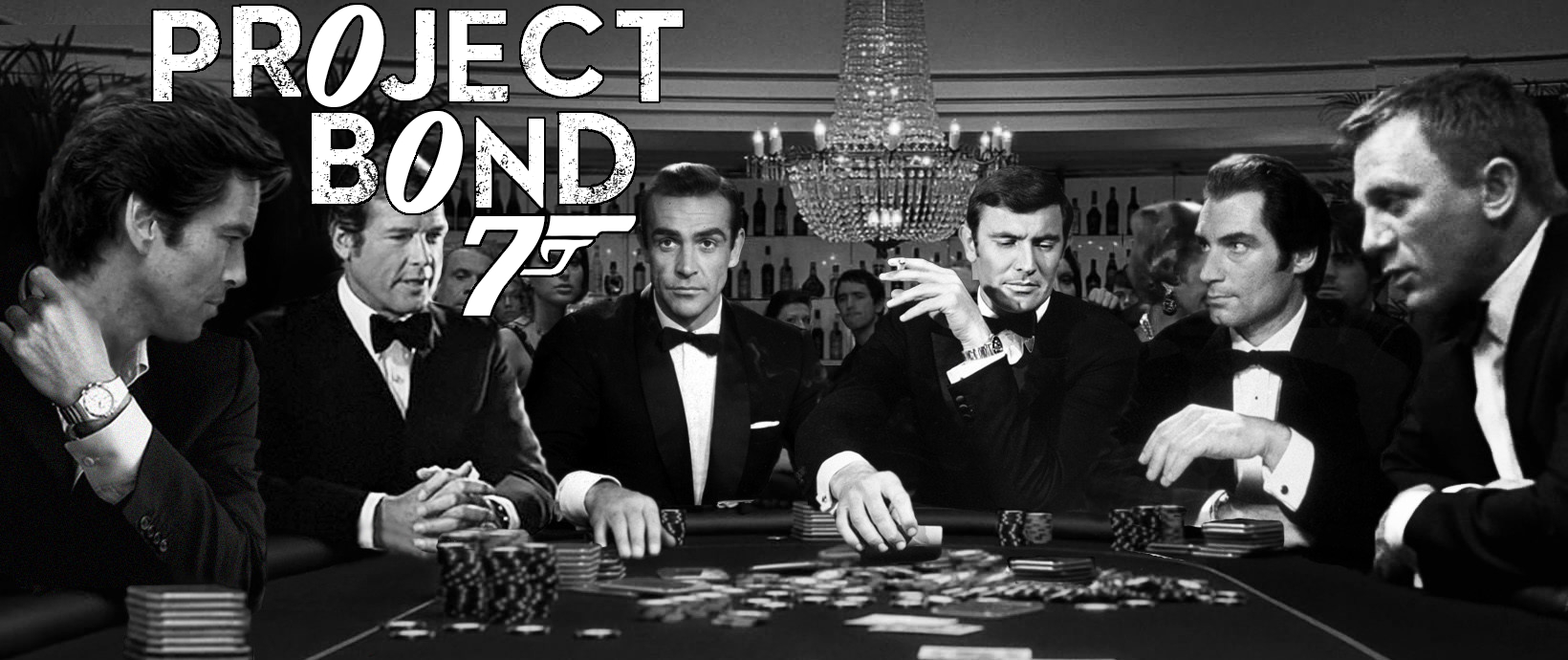
Having come to the end of the 25 James Bond films that currently exist, it’s time to do a wee review of the project overall.
As someone with virtually no experience of Bond, I already knew a fair amount about the series. I could tell you all the actors who had played the role, the order in which they had done so, the status of the two rogue films, name many of the others, and what the man’s favourite beverage is. This isn’t a huge surprise, though; James Bond is one of the biggest film franchises in the world, and has been parodied and referenced extensively. When you absorb as much pop culture as I do, you’re going to pick up things, whether you want to or not.
I had my expectations for the series, some of which were met, some exceeded, and some were way off. As I’ve mentioned before, I wasn’t expecting the films to be quite as silly as many of them (particularly in the Connery and Moore eras) were. Of the trailers and clips I’d seen previously, most were from Brosnan’s and Craig’s films, due to my being a 90s child, so I found the tone a little hard to get used to. As well as this, I was uncomfortable with the amount of sexism and racism found in the early films. Some of this is down to them being of a certain time, hence the reduction in the more recent outings, but some of it is due to Bond (and, to a lesser extent, the spy/action genres overall) being geared toward the laddy lads of lad culture. It’s fair to say that action films (with the obvious exception of Die Hard) are not generally my thing, so there were large chunks of the Bond films I found dull. They were also (particularly during the 70s and 80s) very formulaic and lacking in terms of plot, which at times made me wish I hadn’t committed to the whole thing. However, this was a big gap in my film knowledge that I am pleased to have addressed, and I don’t do things by half measures.
To mark the end of this very special mission, it is time for me to give out a series of meaningless awards that I have called, for want of a better name, The Bondies!
- Best Bond – Timothy Dalton
I’d get hate from young people for saying Connery, and I’d get hate from old people from saying Craig, so I’ve chosen to infuriate everybody. Timothy Dalton was a brilliant Bond, dark and dangerous and exciting, and he came along just when he was needed, to wake up everybody who had nodded off while Roger Moore was smoothing the sleeves of his beigest suit. A reign that was much too short-lived. - Best villain – Elliot Carver
Honourable mention must go to Woody Allen for his stint as Jimmy Bond in Casino Royale, but let’s get serious now. Blofeld, Scaramanga, Goldfinger, Renard, Le Chiffre, Silva, all fantastic villains in their individual ways, but I’ve gone for a bit of an outsider for this one. Carver is a truly terrifying character, because he has no clear motivation. Money? He already has plenty. Influence? See above. He wants to control how everyone in the world sees the aforementioned world, and this is (in theory) quite possible. If that doesn’t scare you, no evil thing will. - Best sidekick – Vesper Lynd
Bond has had many sidekicks to various extents throughout his fifty-year career, but he never had as close a relationship with any as with Vesper. Crucially, none of the others (with the possible exception of Felix Leiter, who may prefer to be called an associate) ever seemed as though they could be Bond’s equal. Very few characters reappear throughout the series, something that had never really bothered me until she came along. There were plenty of options for developing that relationship, but the producers, in their infinite wisdom, opted to leave us wanting more. - Best other character – M
There have been at least three Ms throughout the series so far, but I refer of course to the one who was played by Judi Dench. She was brought into the stories far more than her predecessors, and had an actual personality, which was nice. She was an intelligent woman who was not only accepted in a boys’ club, but fought her way to the top of it. The representation of women in the franchise has historically been somewhere between poor and awful, and Judi turned it round, giving the female audience something worth looking at. - Best film – Casino Royale (2006)
I’ve given all my reasons for liking this film, but I’m not sure I can explain why it was my favourite. A great villain, a great sidekick, a great mission, and a great new Bond. Bringing it back to the start of Bond’s career opened doors to introductions and a learning curve for the central character. There’s too much rebooting in Hollywood these days, but this one was very worthwhile. Any franchise is going to be stale after 20 instalments, and this was exactly what Bond needed. It was the same, but different; they found a new way to do almost everything, and it worked extremely well. - Best era – 90s onwards
For many of the same reasons as given above, Daniel Craig’s reign has been one of the most enjoyable, but I’d like to include Brosnan’s tenure as well. The big gap between Licence To Kill and GoldenEye may well have contributed to the series coming back with a facelift: new Bond, new M, CGI, more ambitious storylines, and more progressive storytelling. The anti-PC brigade will talk wistfully of Sean Connery and Roger Moore tricking women into bed and punching Johnny Foreigner in the face, and how everything was much better then and you can’t do anything nowadays. That’s not to say that these films were bad (although some of them were awful), but that there is no place for them in 2015. (Other things that have no place in 2015 include fluorescent explosions and cardboard sharks.) - Best film for each Bond
For obvious reasons, I haven’t bothered with Lazenby and Niven, as this would be an exercise even more pointless than the rest of this post.
Connery: Diamonds Are Forever
Moore: The Man With The Golden Gun
Dalton: The Living Daylights
Brosnan: Tomorrow Never Dies
Craig: Casino Royale
Project Bond: Skyfall
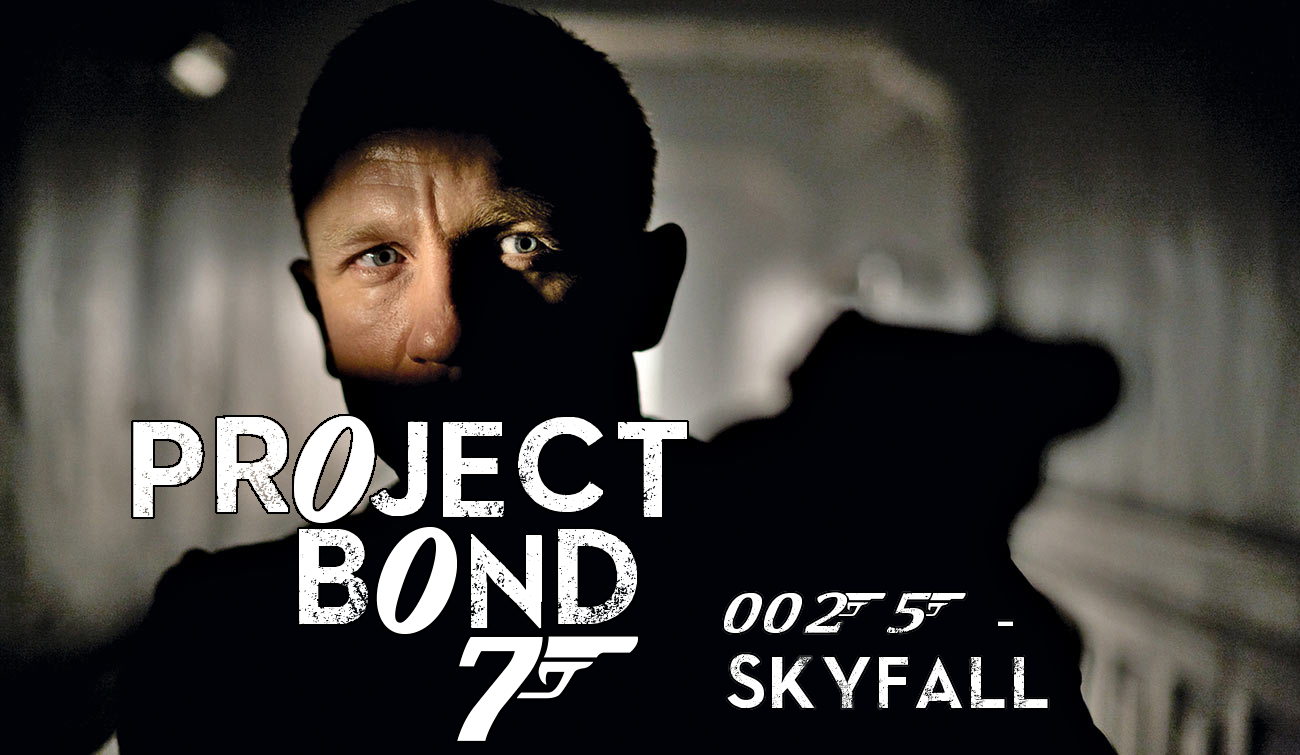
This is it. Number 25. The last one. Skyfall.
Moneypenny’s back. She’s also black, has been given a first name (Eve), and is in the field, which is nice. Bond has a go at her for knocking off a wing mirror during some hot pursuit, and she’s not happy about that. (He also grabs the wheel off her at one point as well, which is not advisable, but then neither is a lot of the stuff Bond gets up to on his adventures.) In the middle of a fight between Bond and a baddie atop a train, Moneypenny has to decide whether or not to shoot, risking hitting Bond. M orders her to shoot; she does, Bond topples out of sight.
Back in London, M has to report to her boss about why things aren’t going so well at MI6. He tells her she’s going to “retire” in a couple of months, and she tells him she “isn’t.” On the way back to the office, the office gets blown up in some kind of terrorist attack. Things are not looking good for M and her leadership.
Then, in a shocking twist, it turns out Bond isn’t dead after all! He turns up at M’s house after seeing the attack on the news, unshaven and unforgiving. M puts him through some tests and fudges the numbers to put him back on active service as ASAP as possible. Her new boss, Voldemort, is a bit of a knob about it, but then he lets it slide with nothing more than a couple of snide comments. Bond is s ent to Shanghai to chase after Patrice, the fella he was fighting on the train. Bond watches him carry out a “hit,” or “murder,” then confronts him about for whom he is working, but Patrice falls to his death without imparting any information.
Bond does, however, encounter an intriguing woman named Sévérine, whom he follows to a casino. She tells him that she works for the same chap as Patrice, and that he will be killed by her bodyguards rather than leave intact. Squeaky bum time! Bond busts his way to freedom using a briefcase full of cash, although he does fall over a balustrade onto a bed of candles. One of the bodyguards tries to shoot Bond with Bond’s special gun that only Bond can fire, and a big alligator type thing runs away with him. Another one almost shoots Bond, before Moneypenny intervenes and they bust their way to freedom.
Bond then breaks into Sévérine’s shower, and she seems dead chuffed to see him, but then she betrays him and Bond finds himself tied to a chair in the secret island of the main antagonist, Raoul Silva (Javier Bardem). It’s been a while since we’ve had an island base. Silva is an unsettling chap, a former MI6 agent with a grudge against M for leaving him in captivity once upon a time. It was he who bombed the MI6 office, as you might have guessed. After a brief chat, Bond overpowers Silva and takes him back to London with relative ease. Too much ease, if you ask me.
Back at the ranch, Q (who is also back, and about 12) is trying to break into Silva’s laptop, but presses the wrong button and accidentally allows him to hack into the MI6 security system, opening his cell and allowing him to escape, which was his plan all along. He dresses up as a polis and ambushes M, but Bond figures out his dastardly scheme in the nick of time and escapes with M. He drives her to Skyfall, his country estate in an unspecified part of Scotland, where he hasn’t returned to since shortly after his parents’ deaths when he was a boy. Q plants a false trail which will lead Silva to them, but only after they have enough preparation time for a showdown.
There have been plenty of bombs during the series, but, unless I’m much mistaken, M drops the first F-bomb during this scene. (She also constructs a nifty nail bomb using a light fitting.) Albert Finney puts in a good turn as Kincade the gamekeeper, who helps Bond and M with their fight, but it was at one stage suggested that Sean Connery might play the part, which would have been perfect for several reasons. As much as I enjoyed the climax of the film, I can’t help seeing it as a bit of a missed opportunity. The house is destroyed and Bond kills Silva, but M dies from her injuries. Following her funeral, it is revealed that Voldemort is the new M, and Moneypenny has had enough of field duty and will be his secretary.
For me, this was one of the most enjoyable films of the series. Craig continues to be a terrific Bond, and Bardem is an excellent villain, unsettling and unreadable in a way very reminiscent of the late Sir Christopher Lee in The Man With The Golden Gun, and his motive of good old-fashioned revenge is one that has been strangely underrepresented in the franchise. It was good to see M as a proper character, not just the bloke in the office at the start of the film who told Bond what to do. I imagine we’ll see more of the same from Ralph Fiennes, if he’s not too busy thinking he’s better than every film he’s in, and mispronouncing his name.
Once again, the gun barrel sequence was moved to the end, which I found strange. Director Sam Mendes explains this as being because it looks very similar to the first scene (Bond walking along a corridor and pointing a gun), but it could have been integrated into the narrative, just as in Casino Royale. A tiny matter, but it just feels like change for change’s sake. Aside from that, though, the series has made some very positive changes in the last couple of decades, which is great to see.
Stay tuned for a round-up of this exciting project very soon!
Project Bond: Quantum Of Solace
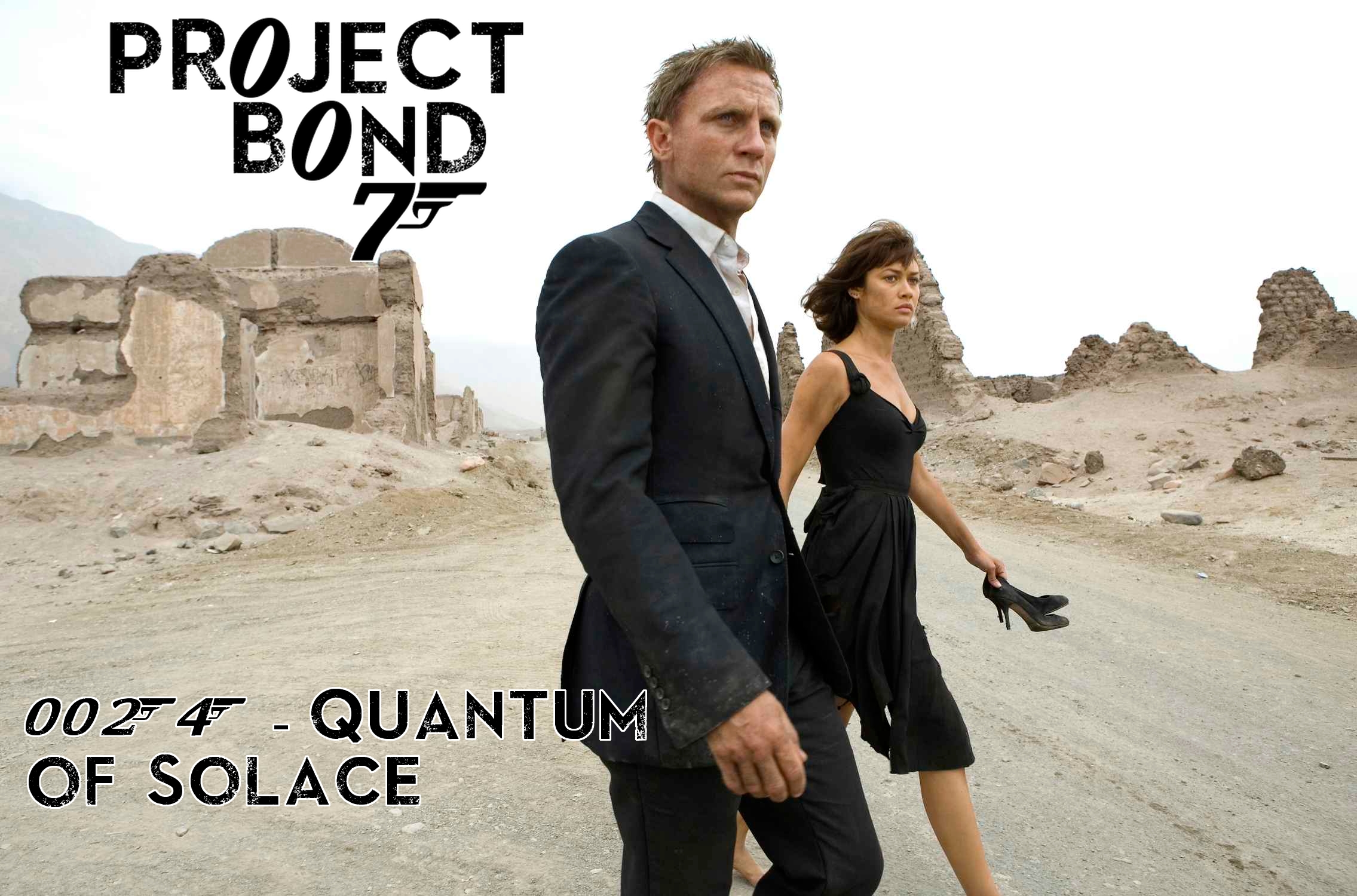
This isn’t a bad film, but it was a bit of a disappointment after the high of Casino Royale. Daniel Craig remains in good form, but that will only take you so far when the script is below par. Quantum of Solace is also noticeably shorter than most Bond films, and is in fact (according to a quick investigation) the shortest of all, at 1 hour 46 minutes, almost 40 minutes shorter than its immediate predecessor.
The franchise continues to break with tradition, with the gun barrel sequence moved all the way to the end for some reason. Unlike previous films, this one serves almost as a sequel, the start of Quantum of Solace following on directly from Casino Royale, with Bond having kidnapped Mr. White. Bond and M interrogate White, who, it turns out, is a member of a pure shady organisation called Quantum. By sheer coincidence, so is M’s bodyguard, Mitchell, who busts White’s way to freedom, and Bond is so mad that he kills Mitchell. Now M is 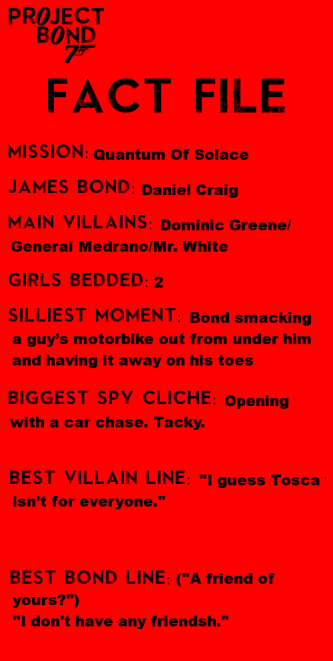 mad because they can’t get any information out of him because he’s dead. Mitchell is probably also mad because he’s dead. White has had it away on his toes, so he’s probably not fussed.
A whole lot of silly events lead Bond to Haiti and another Quantum member, Dominic Greene, who is working for General Medrano, a baddie. Greene is trying to kill his girlfriend for some reason, Camille Montes, so naturally Bond teams up with her, so he is sure to be safe. He goes into the opera and hacks into Quantum’s earpiece chat, thus starting a big fight with guns and everything. A Special Branch guy gets killed, and M thinks it was Bond who done it, so she gets mad again and has all his credit cards stopped.
M sends another agent, named Strawberry Fields for some reason, to bring Bond home. He doesn’t like this idea, so he sleeps with her instead. Then Quantum comes after them and kills Fields in a very crude manner (drowning her in some crude oil), but Bond and Montes escape. Then M herself turns up and suspends Bond (again!), and sends a letter home to his parents. He runs away, then changes his mind and tells M that Fields was dead brave in the field, even though she was ironically not a field agent, which brings M back onto his side for some reason. The CIA is still mad at Bond, though, and only his old pal Felix believes his crazy story, so he helps him escape the CIA.
Meanwhile, Montes has gone after Medrano and killed him because she was so mad, while Bond tracks down Greene and abandons him in the desert with a refreshing can of engine oil. M tells Bond that Greene died, and he says it wasn’t him. M asks him to come back, because she’s not mad any more, and Bond says he never left. Top man.
This one was mostly fine, but a bit flat after Casino Royale. It felt a bit like a bridge film, something to connect the films either side of it, by establishing a criminal network. Quantum also feels like it’s just SPECTRE without the licence, and it’s surely no coincidence that this year’s Bond film will see them return, if the title is anything by which to go. Craig’s Bond is darker and more reckless, blowing cover for no reason but his own comfort, unhappy with the modest hotel Fields selects for them (“we’re teachers on sabbatical and we’ve just won the lottery”). In Casino Royale his room was booked under the name of Beech, but gave both names when checking in, alerting Le Chiffre to his identity. Craziness. Who knows what kind of mad stuff he’s going to get up to next?
Project Bond: Casino Royale (2006)

Meanwhile, back in the Eon series, Pierce Brosnan is gone, and Daniel Craig has arrived. This guy…this is my kinda guy.
The main role has been recast several times, but this is the first true reboot, with a young Bond just achieving 00 status at the start of the film. Everything has changed, except Judi Dench is still M. This doesn’t make much sense, but I’m certainly not complaining. The opening scene (rendered in black and white) sees Bond make the two kills required to earn his licence (to kill, not to drive). Immediately, I am a fan of the steely sass Craig brings to the character, and I couldn’t help grinning most of the way through the credits sequence (in which naked women silhouettes have been replaced with playing card imagery).
I’m not normally a fan of English accents, as they remind me of oppression, but Craig has an excellent voice. Only the second Englishman to play the role in the Eon franchise, Craig’s accent is far more fitting than Pierce Brosnan‘s mid-Atlantic nonsense, which was starting to grate. (I realised while watching Die Another Day that Brosnan sounds very 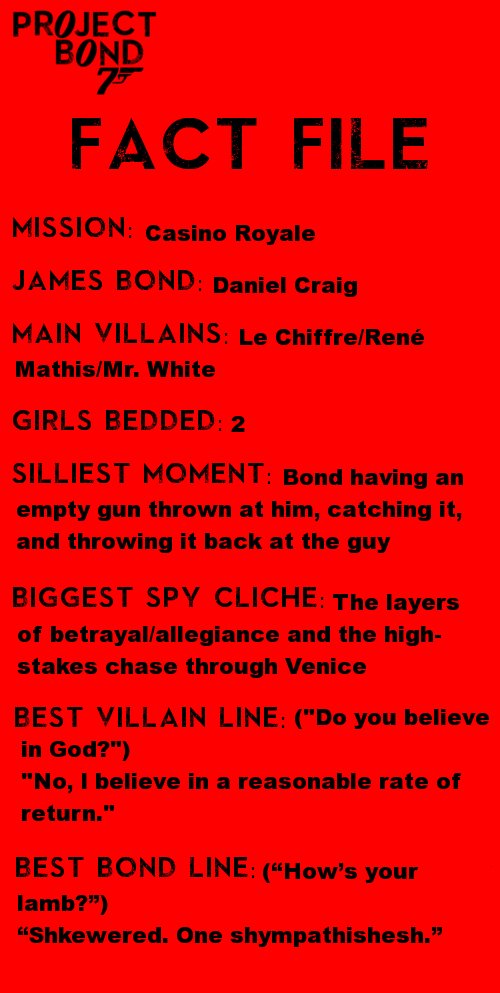 like Gary Oldman, who recently said this.) Craig also doesn’t dress like the other Bonds, wearing short-sleeved shirts, patterned shirts, short-sleeved patterned shirts, and sometimes a suit without a tie! All of these things have been seen before, but rarely, whereas Craig’s Bond seems less concerned with always projecting the suave image favoured by his predecessors. He still cleans up nice, though, and he hasn’t forgotten the basic rules of etiquette that oblige one to change one’s shirt should one soak it in blood while beating someone to death in the middle of a poker game.
This being the first novel, it’s a little strange that Eon had not adapted it before, but I’m glad they left it as long as they did, because this version is excellent. Very truly fantastic and brilliant. It is unrecognisable from the David Niven film of the same name; there’s a casino in it, and the similarities more or less end there. Craig seems immediately very comfortable in the role of James Bond, Le Chiffre is one of the most intriguing villains, and Vesper one of the most memorable Bond Girls. The dynamic between Bond and Vesper is unlike any other in the series; it is quite clear that he does not often develop such feelings for a person, and even when they are at odds, there is a definite closeness between them. The ending is very different from most Bond films, with the mission uncompleted, and he doesn’t get the girl, which is almost unheard of.
Casino Royale breaks quite a few other traditions of the Bond series. For the first time, Miss Moneypenny does not feature, and Q is absent for just the second time. This is also the first Eon film not to open with a gun barrel sequence, and the first to incorporate it into the narrative, thusly framing Bond’s first kill at the start of the opening credits. The film seems to serve as a statement of intent for making progressive changes to the franchise, and left me really looking forward to the next one.
Project Bond: Never Say Never Again

Guessh who’sh back? Yes, it’s Sean Connery, back as Bond after a 12-year absence, during which his trademark speech impediment enhancement seems to have become more pronounced.
Never Say Never Again is effectively a remake of Thunderball, which was based on a novel written by Ian Fleming based on an abandoned script he developed with several other people, including Kevin McClory. (Confused? You will be.) When the novel was published, only Fleming’s name appeared on the cover, which caused problems, not least because the concept of SPECTRE came from the abandoned screenplay. Eon had to reach an agreement with McClory before the film of Thunderball could be made, and he would later prevent them from using SPECTRE in The Spy Who Loved Me. Because McClory retained the rights to SPECTRE (and, of course, Blofeld), he was able to make Never Say Never Again without Eon being able to block him (as long as he waited 10 years after Thunderball‘s release). He offered Connery a big pile of cash to reprise the role of Bond, with the film being released around the same time as Roger Moore’s Octopussy.
Bond is getting older, something that is acknowledged frequently in this film but not in Octopussy, despite Moore’s being three years older than Connery. (A lot of this is tongue-in-cheek acknowledgement that Conne ry hasn’t played the role for some time, and is now back.) The ancient Bond is sent to a health clinic to get himself back into shape, where he discovers trouble a-brewin’. He finds Fatima Blush, a SPECTRE operative posing as a nurse, and she’s stealing weapons! Her pal Petachi has borrowed the US President’s eye to mess with the iris-recognition software that protects some bombs. Then it turns out they weren’t really pals, because Blush kills him.
Bond goes after another SPECTRE guy, Maximillian Largo (whose girlfriend Kim Basinger happens to be Petachi’s sister), in the Bahamas. There he meets Rowan Atkinson, who tells him to go to Nice instead. In Nice, Bond beats Largo at a computer game before being kidnapped by Blush, which angers him so he shoots her with a fountain pen, as you do. Ever the clumso, Bond is kidnapped again, this time by Largo and along with Kim Basinger, who he inevitably has to rescue, of course. The pair of them then track down and kill Largo in yet another underwater fight, which was easier to follow than in Thunderball, but it’s still not a great medium for telling stories. The ending of the film was further let down by Connery’s cheesy wink to the camera.
This is a bit of a strange film, in that it’s not the same as Thunderball, but not different enough to really merit a retelling. However, it’s great to see Connery back to skulking and brooding around with his eyebrows going, looking like he hasn’t skipped a day, which must have provided a bit of a relief from Roger Moore in the mid-80s. Max von Sydow is the most forgettable Blofeld; his cat looks like it is either too big for him, or it was liable to run away, because he grips it very tightly and it looks distinctly odd. The film was developed over a long period, with Connery brought in as a consultant before taking on the lead role again. Various writers worked on the screenplay, including the uncredited Dick Clement and Ian La Frenais, who resued a classic Porridge joke, which was Bond’s best line in the film (see above).
Obviously the primary motivation behind making this film for all involved was money, but it’s nice to imagine Connery wanted to show Roger Moore “thish ish how it’sh done.” Overall it was a worthwhile effort, and a more entertaining film than Thunderball, but still something of an oddity in terms of the Bond films overall.
Project Bond: Casino Royale (1967)
In a slight change to the schedule, I’ve decided to slot in the non-Eon films here, because I believe the changeover from Pierce Brosnan to Daniel Craig serves as something of a reboot, so this seems an ideal opportunity for something completely different. (I also doubt that I’d be entertained by this version of Casino Royale after watching Craig’s, with no disrespect meant to David Niven.)
Well, now. At first, I had no idea what to make of this highly ridiculous film. As time went on, though, I found myself enjoying it more and more, but only because it was so very, very daft. This rather farcical film reminded me very strongly of The Pink Panther, and not just because of the presence of David Niven and P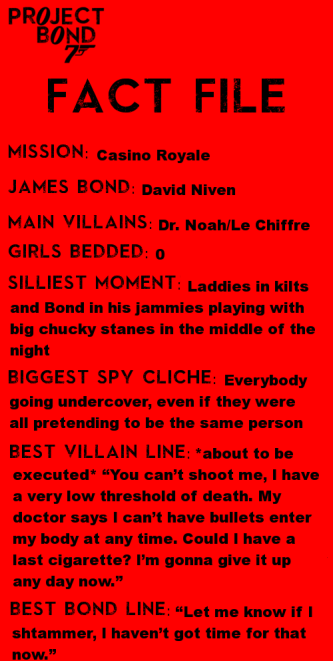 eter Sellers, although that did help. The tone is very much tongue-in-cheek, almost like a send-up of the early Eon films, which I suppose is what it was intended to be.
We meet an older James Bond, retired, being invited back to MI6 to deal with SMERSH, which is a thing. This Bond, however, is enjoying the quiet life, and is content to sit back in his mansion house, twiddling his wee moustache. Niven’s wee twiddly moustache, incidentally, makes him the only Bond so far to have facial hair (other than Brosnan’s brief, unintentional beard growth in Die Another Day). He eventually agrees to return after being made head of MI6, when M is killed in his attempt to blow up Bond’s house. As you do. Before that, however, Bond has to go up to Scotland to pay his respects to M’s wife, because to do anything else would be considered rude. There are then some scenes in a castle featuring truly awful Scottish accents, if you’re into that sort of thing. Upon his return to work, Bond orders that all MI6 agents are renamed James Bond, for some reason, including Evelyn Tremble (Sellers). (It is interesting to note that Sellers is credited above Niven here, while Niven is billed before Sellers in The Pink Panther, in which Sellers plays the lead. Then again, it’s possible that Sellers actually has more screen time than Niven in Casino Royale, his role being less prominent than that of the ‘real’ Bonds.)
Bond tracks down his estranged daughter and sends her to Berlin (in a taxi, from London, somehow) to infiltrate SMERSH. Meanwhile, Tremble is taking on Orson Welles at baccarat in a casino (nudge nudge, etc.) using some magic sunglasses. In his fury at being beaten, Orson Welles jumps into Tremble’s mind for some reason, and sends him round the twist. He is eventually killed, much to the envy of everyone else still in this madhouse.
This film features such silly things as Woody Allen, Peter Sellers, and Woody Allen jumping over a wall to escape a firing squad, only to land in front of another firing squad. Sellers is, as ever, excellent value, with far too many great lines to include here. (“Isn’t Evelyn a girl’s name?” “No, it’s mine.”) Allen, too, is very funny, and I suspect wrote some of his own dialogue, since it’s just so perfectly him. Even at their silliest, the Eon Bond films were never as silly as this. I’m hoping for something a bit less ridiculous from Never Say Never Again, not that this wasn’t enjoyable, as a one-off.
Project Bond: Die Another Day
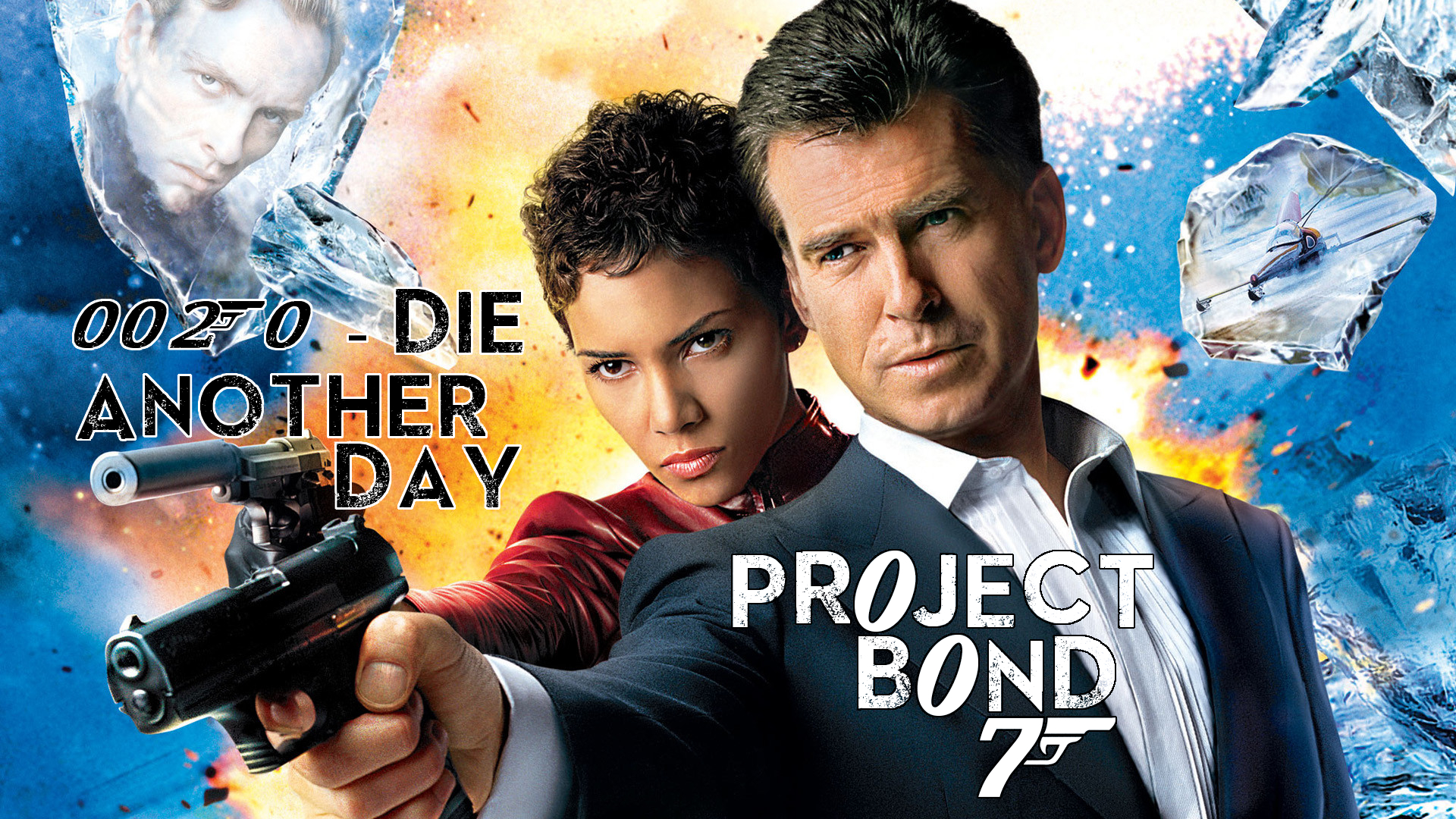
I thought this effort was a very disappointing end to the Pierce Brosnan era. Brosnan hasn’t been my favourite Bond, but prior to this film, I thought his tenure had had the most consistently high quality, all things considered. Die Another Day, while entertaining enough in places, felt like a lazy attempt to pull together all the best bits of the previous films in the hope that it would work. It didn’t.
Bond has his licence to kill revoked (again) over fears that he may have given away information (without knowing it) while he was held in North Korea for a year, during which time he grew quite a nice beard. He breaks free from MI6 and follows Zao, 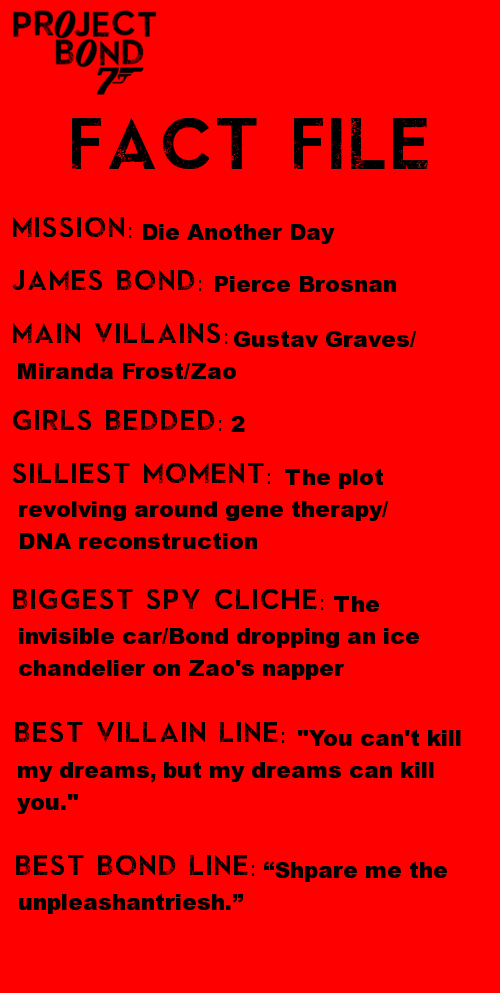 the man who betrayed him, to Cuba. There he meets Halle Berry who is also investigating Zao, and they track him to a gene therapy clinic. He escapes, but leaves behind some diamonds that Bond traces to Gustav Graves, a rich English guy. Back in London, he meets Graves and his assistant, Rosamund Pike, who is quite good at fencing. She’s also an undercover MI6 agent, keeping an eye on Graves. Bond and Graves have a game of fencing, which then turns into a full-on sword fight, of which Bond is the victor.
Now believing his crazy story, M reinstates Bond and helps him chase down Graves, who it turns out is actually Colonel Moon, Zao’s boss who Bond was chasing in the first place! Crazy. As is his wont, Bond attempts to seduce Rosamund Pike with a series of awful innuendos, presumably believing her to be Cool Girl. This works, but only because it is to her advantage, for you see, she is one of those double agents! They thought she was on their side, but she was on Moon’s side! Crazy. You couldn’t make it up. Now Bond has to rescue Halle Berry, who has been captured by Moon, which he does successfully because he has an invisible car. Then there’s a mad bit in which Bond shoots down an ice chandelier to kill Zao, and Halle Berry drowns, except then Bond saves her somehow. Crazy.
The end is rather predictable: the good girl kills the bad girl, the good guy kills the bad guy, happily ever after, etc. It’s not the worst of the Bond films I’ve seen, but it’s one of the most forgettable, and shows that having a bunch of stuff that works well on paper doesn’t always work in practice.
Project Bond: The World Is Not Enough
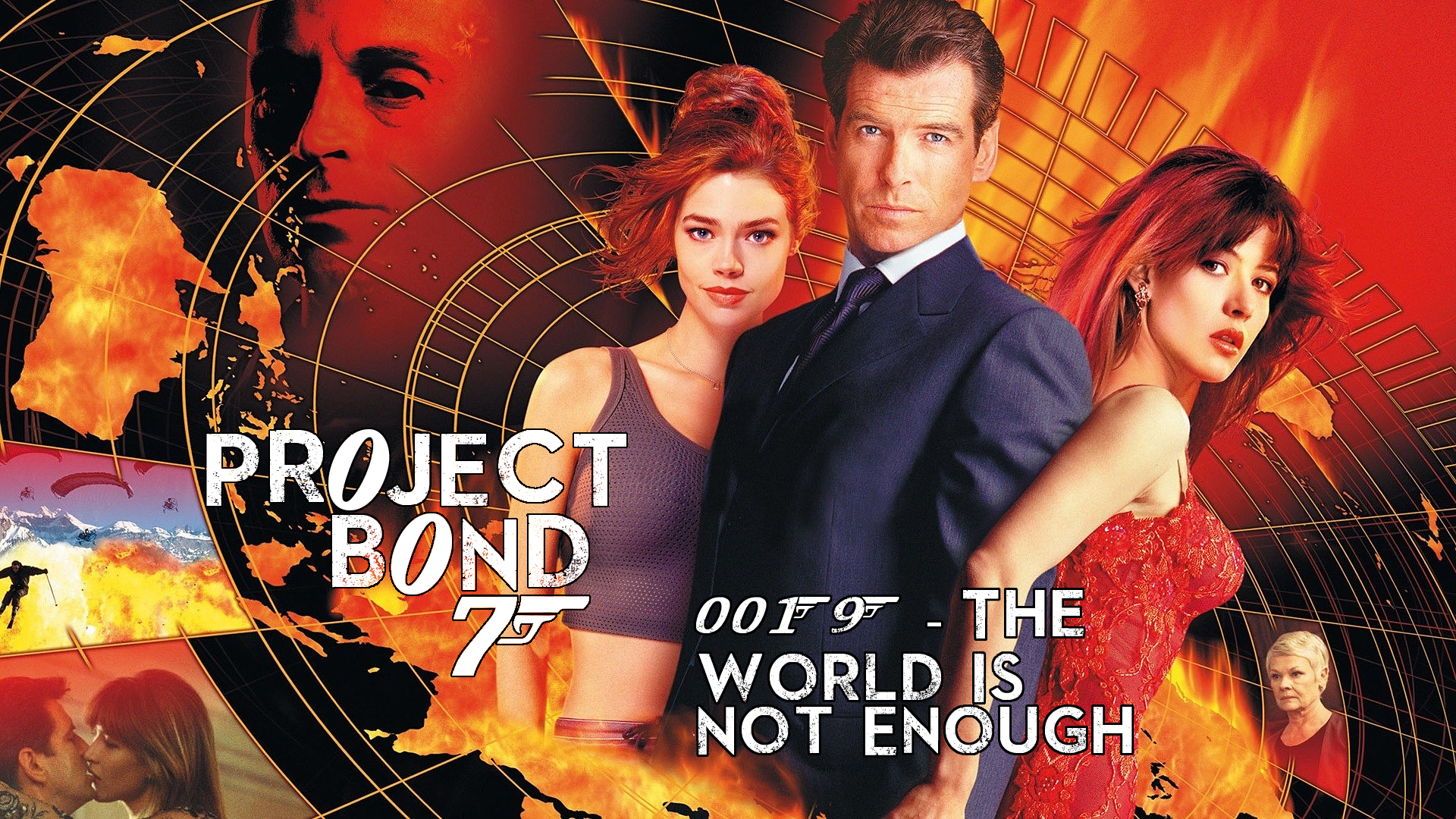
This was another cracker, with plenty more familiar faces. The first scene sees a group of Spaniards burst into a room shouting, but sadly, they do not exclaim what you might hope they would, despite John Cleese making an appearance in the film. Bond is then involved in a speed boat/hot air balloon chase, before he is dropped onto the roof of the Millennium Dome, in what is surely the longest pre-title sequence yet.
There is an early scene at the beautiful Eilean Donan castle, featuring some mad science explanations for how come Sir Robert King (an old friend of M’s) set off a bomb that killed him, which was concealed in a big pile of cash. This sequence also marks the 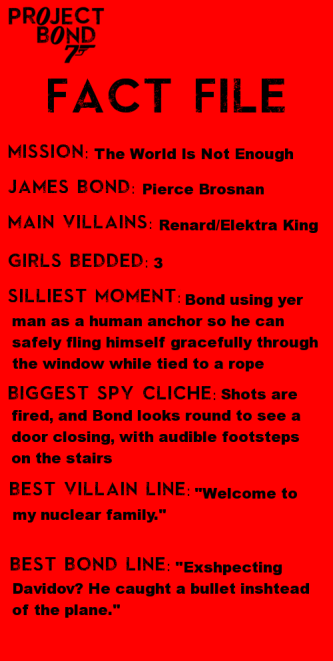 final appearance of Desmond Llewelyn, who played Q for the 17th time, meaning he has appeared in more Bond films than any other actor. He introduces us to his successor, John Cleese (or “R,” as Bond hilariously dubs him), before disappearing beneath the floor for some reason. Llewelyn died a few weeks after the film was released.
Robbie Coltrane makes a welcome return, but following Alan Cumming’s explosive death in GoldenEye, the producers apparently felt there were too few Scots playing Russians, so Robert Carlyle turns up as Renard, a former KGB agent and current terrorist, who feels no pain due to a bullet lodged in his brain. Just as when playing Hitler, though, Carlyle does not inspire quite the level of terror he reached as Francis “Frank” “Franco” “Psycho” “Beggar Boy” Begbie.
Bond is working with Elektra King to find her father’s killer (Renard), who previously kidnapped Elektra and held her for ransom, but he’s also two-timing her with Denise Richards. Then it turns out Elektra has been working with Renard the whole time, due to her having been infected with Stockholm Disease! It was in fact she who killed her father, for some reason angry at his refusing to pay the ransom when she was abducted by Renard. She almost kills Bond and Denise Richards, and kidnaps M, who advised King not to pay the aforementioned ransom.
But then M dials M for MacGyver and takes the wire out of the clock Renard gifted her to count down to her death, and reinvigorates the bomb that had been left in her cell for some reason, thus busting her way to freedom. Bond, meanwhile, looks sure to die at the hands of Elektra, until Robbie Coltrane turns up. Elektra shoots him, but with his dying breath, he helps Bond bust his way to freedom. He kills Elektra, and later finishes off Renard, while also busting Denise Richards’s way to freedom. Happy days!
The formula that was so evident during the Moore years is still present, but it is more flexible now, and the stories more individual. The advances of CGI technology have of course made the films look better, but have also allowed the stories to become bigger, if also sillier in places. While the concept of Bond Girls has not always been terribly consistent with the feminist movement, we are now seeing some more three-dimensional roles for women in the franchise (M among them), which is nice, and the stereotypical foreign baddies have also been toned down considerably. Happy days!
Project Bond: Tomorrow Never Dies
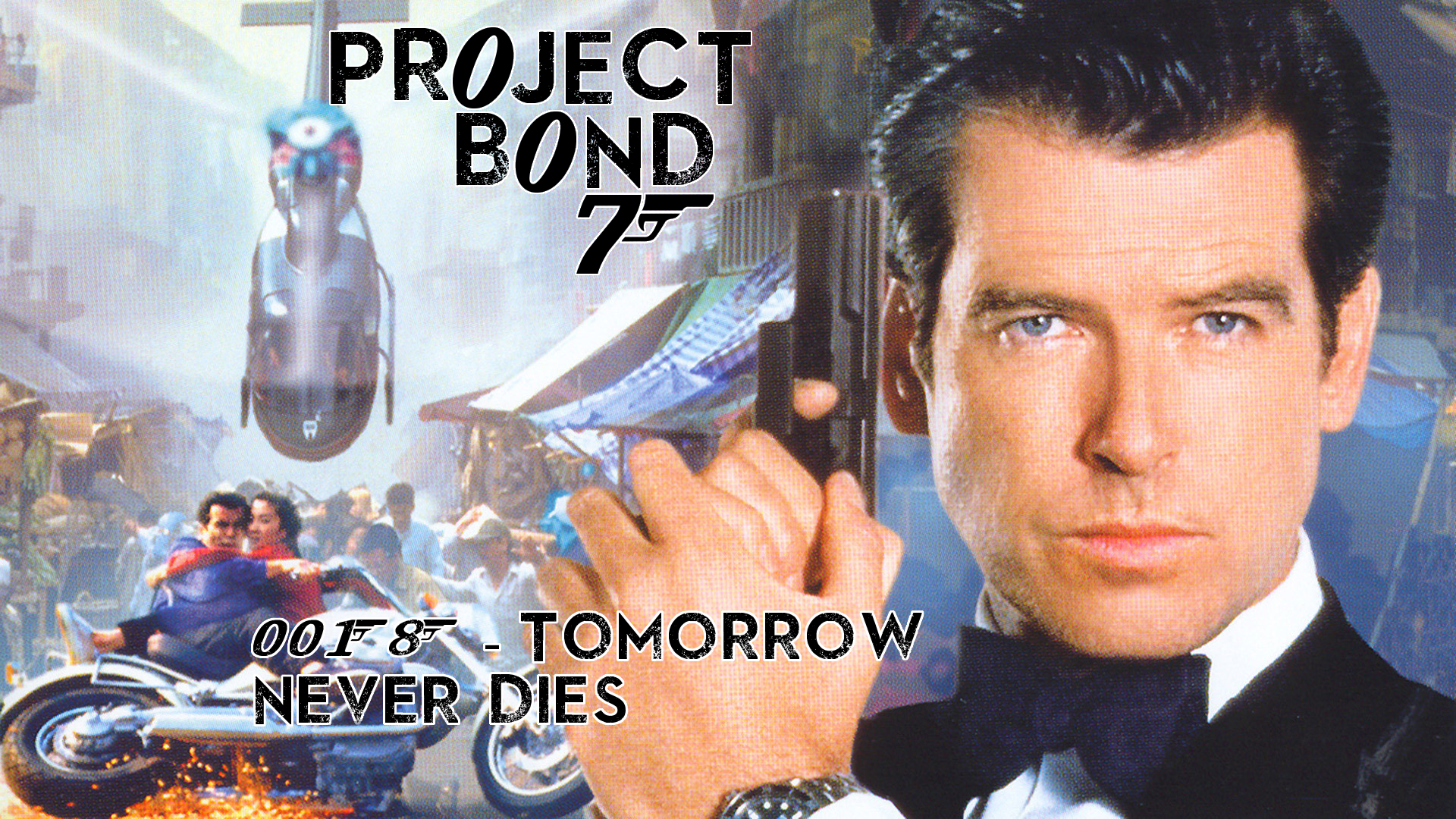
We start with Bond away flying a plane somewhere, while Geoffrey Palmer shouts at his wife Judi Dench to call him off. She does, but he doesn’t, and Bond wins as usual. All is well, but not for long, because some British sailors are killed/murdered, and media mogul Elliot Carver appears to know about such happenings before they happen. Curiouser and curiouser.
Carver (Jonathan Pryce) is trying to start a war between China and the UK, because he wants a monopoly on Chinese media as well as all other media, so he’s after China getting a new government to help along his dastardly scheme. Meanwhile, the waters are muddied further by Carver’s wife Paris (Teri Hatcher) being one of Bond’s ex-girlfriends (which, statistically, was bound to happen eventually). He seduces her as a means to the end of getting information on her husband, something that she seems fairly willing to allow. Meanwhile, Carver is keeping a close watch on his wife, presumably to find out if they’re real and/or spectacular, or maybe he 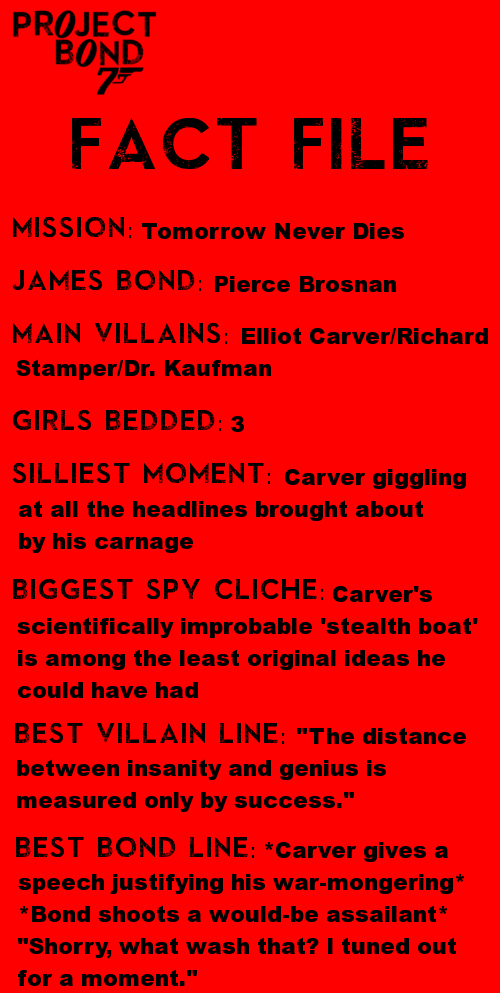 doesn’t trust her or something. He asks Paris how she knows Bond after seeing them talking at one of his mad parties, but doesn’t believe her answer. Carver grows suspicious of his wife’s past with Bond and, after having his Computer Man investigate, orders them both killed. His Hard Man kills Paris, but Bond escapes with Carver’s GPS gadget (something that was probably an intriguing object and A Big Deal 20 years ago), before heading off to the South China Sea to find out what happened to the boat that got sunk.
In an underwater scene that is much easier to follow than Thunderball, Bond meets Wai Lin, a Chinese spy who is also after Carver. He suggests they team up, but she’s having none of it until he saves her a couple of times, after which she invites him back to her place, which is full of cracking gadgets and would-be assailants, of whom Wai Lin and Bond soon dispose. As they are trying to get into Carver’s ‘stealth boat,’ Wai Lin is captured and her life used as leverage against Bond. Rather than doing the sensible thing, Bond heroically saves her and destealthifies the ship, at which point China and the UK both attack it. Bond kills Carver with a big drill thing, and saves Wai Lin yet again from Carver’s Hench Man, who is killed in the explosion that Bond escapes with seconds left to play. Happy days.
I enjoyed this film more retrospectively than I did while watching it. Pryce is an excellent villain, walking a fine line between cartoonish and plausible, and I enjoyed the story surrounding his motivation. Brosnan plays Bond almost as a cross between Moore and Dalton, dignified and dark, but he also has a playful side to him that is more reminiscent of Connery. With technology advancing and film budgets booming, it looks as though the producers are going a lot bigger than they did in previous decades, and it’s working so far.
 Colm Currie
