Colm Currie
Writing things so you don't have to
Project Bond: The World Is Not Enough
This was another cracker, with plenty more familiar faces. The first scene sees a group of Spaniards burst into a room shouting, but sadly, they do not exclaim what you might hope they would, despite John Cleese making an appearance in the film. Bond is then involved in a speed boat/hot air balloon chase, before he is dropped onto the roof of the Millennium Dome, in what is surely the longest pre-title sequence yet.
There is an early scene at the beautiful Eilean Donan castle, featuring some mad science explanations for how come Sir Robert King (an old friend of M’s) set off a bomb that killed him, which was concealed in a big pile of cash. This sequence also marks the 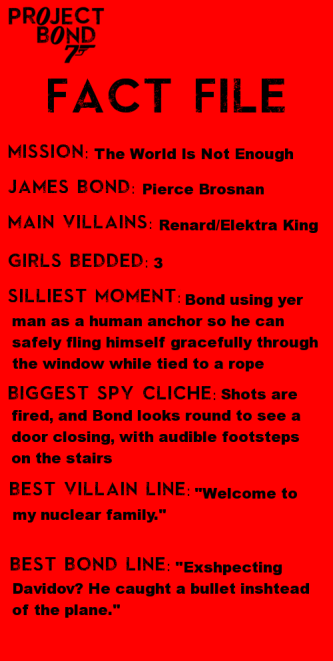 final appearance of Desmond Llewelyn, who played Q for the 17th time, meaning he has appeared in more Bond films than any other actor. He introduces us to his successor, John Cleese (or “R,” as Bond hilariously dubs him), before disappearing beneath the floor for some reason. Llewelyn died a few weeks after the film was released.
Robbie Coltrane makes a welcome return, but following Alan Cumming’s explosive death in GoldenEye, the producers apparently felt there were too few Scots playing Russians, so Robert Carlyle turns up as Renard, a former KGB agent and current terrorist, who feels no pain due to a bullet lodged in his brain. Just as when playing Hitler, though, Carlyle does not inspire quite the level of terror he reached as Francis “Frank” “Franco” “Psycho” “Beggar Boy” Begbie.
Bond is working with Elektra King to find her father’s killer (Renard), who previously kidnapped Elektra and held her for ransom, but he’s also two-timing her with Denise Richards. Then it turns out Elektra has been working with Renard the whole time, due to her having been infected with Stockholm Disease! It was in fact she who killed her father, for some reason angry at his refusing to pay the ransom when she was abducted by Renard. She almost kills Bond and Denise Richards, and kidnaps M, who advised King not to pay the aforementioned ransom.
But then M dials M for MacGyver and takes the wire out of the clock Renard gifted her to count down to her death, and reinvigorates the bomb that had been left in her cell for some reason, thus busting her way to freedom. Bond, meanwhile, looks sure to die at the hands of Elektra, until Robbie Coltrane turns up. Elektra shoots him, but with his dying breath, he helps Bond bust his way to freedom. He kills Elektra, and later finishes off Renard, while also busting Denise Richards’s way to freedom. Happy days!
The formula that was so evident during the Moore years is still present, but it is more flexible now, and the stories more individual. The advances of CGI technology have of course made the films look better, but have also allowed the stories to become bigger, if also sillier in places. While the concept of Bond Girls has not always been terribly consistent with the feminist movement, we are now seeing some more three-dimensional roles for women in the franchise (M among them), which is nice, and the stereotypical foreign baddies have also been toned down considerably. Happy days!
 Colm Currie