Colm Currie
Writing things so you don't have to
Reading Challenge 2017
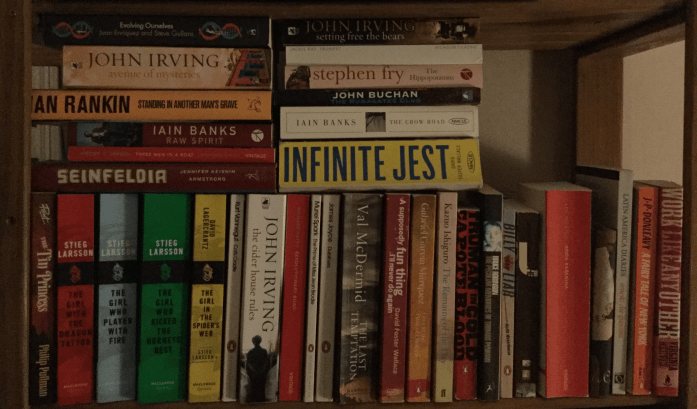
I’m a little late with this one, due to having other stuff going on in my life. (Not really, I’m just a bit slow.) Having gone along with pre-prepared book challenges the last couple of years, in late 2016, my pals Simon and Tom and I decided we would compose our own for 2017. We came up with 50 categories between us, with the plan being to aim for 40 of our choosing, and then onto the last 10 if we had time remaining. None of us made it even to 40, but we had fun trying. Below is the story of my valiant attempt.
Title: The Tin Princess
Author: Philip Pullman
Year published: 1994
Date finished: 2nd January
Criteria fulfilled: A book you started in 2016
Comments: Once I’d started reading this, I realised I had never finished it the first time round. I was expecting it to focus on Sally Lockhart, but she only makes brief appearances at the beginning and end, with the main character of this adventure instead being Jim Taylor. The political narrative had perhaps been a bit heavy for my 13- or 14-year-old self, but this time around, I found it much more interesting. It’s quite a tonal departure from the rest of the series, but I enjoyed it all the same.
Title: The Girl With The Dragon Tattoo
Author: Stieg Larsson
Year published: 2005
Date finished: 10th January
Criteria fulfilled: A book with a map in it
Comments: These books became international sensations during my shameful non-reading phase, so they had passed me by entirely. I had tried and failed to fit them into previous reading challenges, but this one has a map in it, so that was just great. I discovered quickly that this book was nothing like I had expected it to be, but I was soon engrossed. The mystery gradually being unpicked, as well as the theme of a big family full of beef and secrets, reminded me of my dear friend Iain Banks, particularly the part with the pressed flowers, which is reminiscent of the matchbooks in The Crow Road, although with a very different outcome. I very much enjoyed unwinding this book as I went along, which is just as well, because I’d already bought the other ones.
Title: The Girl Who Played With Fire
Author: Stieg Larsson
Year published: 2006
Date finished: 18th January
Criteria fulfilled: A book published posthumously
Comments: Unlike its predecessor, which stands alone, this one is part of a much bigger story. You don’t need to read the first one first, as most of the key things you need to know are explained, although I would suggest you do so anyway. It focuses much more on the titular girl than the first one, which I thought made more sense. It feels as though Larsson started writing this story, then realised it was far too big for one book and had to split it into two, although I might well be mistaken. Despite the fact that so much of the story is unresolved at the end, it actually works quite well on its own, wrapping up in a somewhat satisfactory manner, but you do then need to keep reading.
Title: The Girl Who Kicked The Hornets’ Nest
Author: Stieg Larsson
Year published: 2007
Date finished: 28th January
Criteria fulfilled: A book over 500 pages long
Comments: Early on, I thought I wasn’t going to like this one as much as the others. A lot of the book is building up to a courtroom drama, which can work quite well on film, but I didn’t expect it would in written form. Boy, was I wrong. (Yes, I was.) There were a couple of sections which felt a little too long-winded, but for the most part I thought it was very well-paced and just as thrilling as the more action-packed first two books in the series.
Title: The Girl In The Spider’s Web
Author: David Lagercrantz
Year published: 2015
Date finished: 5th February
Criteria fulfilled: A book with an insect in the title (or spider, fly, etc.)
Comments: Reading this one straight after the first three, as most people probably didn’t, was quite interesting. There were some who didn’t care for Lagercrantz’s continuation of the series, and some who were opposed to it in principle, but reception had mostly been quite positive, I gathered. To me, the two main characters felt exactly right, although some of the supporting cast were a little off. The syntax is slightly different from Larsson’s, although Lagercrantz has obviously tried to make it as close to the original as possible, and this may also be down to this book having been translated by a different person. While this was not as good as the first books in the series, I enjoyed it, and for anyone who isn’t sure, I’d say it’s a worthy continuation.
Title: Cat’s Cradle
Author: Kurt Vonnegut
Year published: 1963
Date finished: 10th February
Criteria fulfilled: A Penguin Modern Classic
Comments: It’s been a while since I read Vonnegut, so I’d forgotten how absolutely bonkers his writing is. From the preposterously short chapters to the ludicrous content that fills them, everything about this book is unconventional and unsane. I loved it. Cat’s Cradle is only 200 pages long, but he sure crams a lot in there. It was more different from Slaughterhouse-Five than I’d expected it to be, but the style was very familiar, and I was pleased to be back in his company, so pleased that I will see if I can’t match up another of his works to a category.
Title: The Cider House Rules
Author: John Irving
Year published: 1985
Date finished: 20th February
Criteria fulfilled: A book that had an Oscar (TM) winning movie based on it (Best Film, Best Director, Best Adapted Screenplay)
Comments: The first sentence of this book is about circumcision. A bold opening, but a sensible one, because if you can’t handle that, you’re not going to cope well with what follows. I’m not sure if this is my favourite of the John Irvings I’ve read, but it’s certainly a contender. It’s incredibly emotive, but also extremely graphic and very funny, so it’s rather an intense read. If you’ve seen the film but never read the book, I’d recommend sorting that. The film is excellent, but loses so much of the source material, largely because it’s over 700 pages long. The only thing about the book I didn’t like is that I spent a good while waiting for something specific to happen. Once I realised it was never going to happen, and I got where it was going, I was back on board. It’s a belter. An absolute belter. Might be the best book I read in 2018. It really is very, very good.
Title: Revolutionary Road
Author: Richard Yates
Year published: 1961
Date finished: 25th February
Criteria fulfilled: Your friend’s favourite book
Comments: Oh, boy. This was a real rollercoaster. By the time I was finished, I had already figured out what I wanted from life three times and abandoned my findings five times. This story of a suburban couple who are unhappy on the surface, and miserable underneath, kept me more interested than I can ever recall being in a story that was purely about a relationship. Yet it was about more than a relationship – it was about two people who may or may not know each other on a more than superficial level despite having been married for years. How much does one ever truly know another person? Well, after reading this, I still don’t know, but at least now I know that I don’t know. You can be as interesting or as beautiful as you like, and that might be enough for somebody else today, but it might not tomorrow. If I learned anything from this book, and I assume that I did, it was probably that I should stop doing things I don’t enjoy immediately and start doing the things I do enjoy.
Title: The Prime Of Miss Jean Brodie
Author: Muriel Spark
Year published: 1961
Date finished: 27th February
Criteria fulfilled: A book by a Scottish female author
Comments: While I should definitely have read this book before I did, I’m glad I read it while I still had some of my prime left to dedicate to better things. Of course, I haven’t yet done so, but it’s bound to happen if I keep meaning to. It’s a charming tale of a prim Edinburgh schoolteacher, as you quite probably already know, who mentors a group of largely ungrateful young girls. However, there is a certain darkness to it, so if you can’t handle that, I’d leave it alone.
Title: Dubliners
Author: James Joyce
Year published: 1914
Date finished: 3rd March
Criteria fulfilled: A book of short stories
Comments: Goodness me, Jimbo is tough to read. He’s got quite an imagination on him, though, so overall it’s probably worth it. I liked most of these stories, and the world Joyce paints that is Joyce’s Dublin, but I’m not sure if I’d want to commit to something longer like Ulysses. I probably will, though. That sounds like something I would do.
Title: The Last Temptation
Author: Val McDermid
Year published: 2002
Date finished: 9th March
Criteria fulfilled: A sequel
Comments: The third instalment in the Tony Hill and Carol Jordan series that I so enjoy. One downside of these challenges is that it makes it rather difficult to read series of books, which meant it took me a bit of time to get back into the characters. I was a little disappointed with the ending of this book, which felt a bit flat, but overall it was an entertaining read, with well-woven plots that linked together nicely.
Title: A Supposedly Fun Thing I’ll Never Do Again
Author: David Foster Wallace
Year published: 1997
Date finished: 18th March
Criteria fulfilled: A non-fiction book by an author who is more famous for writing fiction, or vice versa
Comments: A supposedly good author I’ll never read again.
I’m joking, of course, I was simply demonstrating how easy it would be to turn his title around on him and make him look a fool. Most famous for his caramel magnum opus, Infinite Jest, David Foster Wallace also once went on a cruise, as documented in the titular essay of this collection. He writes extensively and lucratively on a number of topics, including tennis (which he used to play to a not insignificant level), a carnival or fair (which he attended), David Lynch (which he met once), US fiction (about which he knows a thing or two), and a cruise (upon which he embarked). I was put in mind of yet another David, Sedaris, by whom you may recall I read an essay collection two years ago. Wallace is definitely the superior writer, although in Sedaris’ defence, I would like to point out that sometimes less is more. It wouldn’t hurt to cut the odd paragraph or eight, and the footnotes could do with being shorter. (TOP TIP – when your footnotes have footnotes, they are either extraneous or important enough to be in the main text.) Otherwise, good.
Title: Love In The Time Of Cholera
Author: Gabriel Garcia Marquez
Year published: 1985
Date finished: 3rd April
Criteria fulfilled: A book by a Nobel laureate
Comments: One of my favourite things about this book was that the characters all had different names, thus making it possible to follow what was going on, unlike certain other books I could name but won’t (One Hundred Years Of Solitude, for instance). I enjoyed this one a lot more. The plot was very engaging, despite the reader knowing (pretty much) how it would end from very early on. There aren’t a lot of laughs, but when they do come, they’re usually very big. Marquez’s style is quite strange, in that most of the time he is serious, but at other times, he allows silliness to take over and utterly ridiculous things happen. A strange chap, but an interesting one.
Title: The Remains Of The Day
Author: Kazuo Ishiguro
Year published: 1989
Date finished: 12th April
Criteria fulfilled: A book with an unreliable narrator
Comments: Goodness me, what an unreliable narrator. He’s all over the place! He contradicts himself, he forgets when things happened, what they were, and who was there. Box well and truly ticked. I really enjoyed reading this book. The plot is minimal, but for such a short work, it packs a lot in in terms of themes. It had plenty of that self-aware-posh-charm that I like so much, and is full of pauses for thought and reminiscences. I can see why the Booker Brothers chose to award it their prize.
Title: In Cold Blood
Author: Truman Capote
Year published: 1966
Date finished: 5th May
Criteria fulfilled: A true crime book
Comments: This is a true story, you know. A true story of some rather horrible murders, if you can believe such a thing. It wasn’t a story I knew anything about when I started reading the book, but by the time I had finished reading the book, I knew loads about it. There is of course some fiction to it, to make it more like a novel and less like a textbook, but for the most part, it’s true. Capote spent six years researching the story, hence the three narratives following the victims, the killers, and members of the community affected. A very interesting book, and one which might not have been the start of a new genre, but certainly popularised it.
Title: The Peculiar Memories Of Thomas Penman
Author: Bruce Robinson
Year published: 1998
Date finished: 6th May
Criteria fulfilled: A book you pick up in a book swap
Comments: I obtained this one from my pal John, who had bought a copy online, only to find that the spine was sun-bleached. He bought a second copy, which was the same. He eventually went out and bought one with no superficial damage from an actual bookshop. Sensing an opportunity, I took one of the rejected copies from him and gave him a book of my own in its stead (The Steep Approach To Garbadale by Iain Banks, if you must know), and read it in two days, possibly entirely on trains. It’s horrendously disgusting, but as this is exactly what I was expecting, I didn’t really mind. I was also expecting it to be very funny, which it was. Everybody’s happy, except perhaps for John.
Title: Billy Liar
Author: Keith Waterhouse
Year published: 1959
Date finished: 14th May
Criteria fulfilled: A book you bought in a different country
Comments: I took advantage of being in London for my pal Dan’s 40th birthday, and bought this book which had been recommended to me by several people. I found it quite similar to the book I had just read, at least in terms of story if not style, focusing as it does on a young man who nobody believes. The difference is, of course, that Billy Liar is lying, and it does him no good at all. It’s terribly funny, though more than a little sad, and nowhere near as long as you’d think given it took me eight days to read it.
Title: The Fuck-Up
Author: Arthur Nersesian
Year published: 1997
Date finished: 21st May
Criteria fulfilled: A book with a swear word in the title
Comments: I’m so glad I came up with this category, because I might otherwise have never read this excellent book. It follows a man around New York as he gradually dismantles his own life and interferes in others’, hence the title. It’s horrifying in places, but it’s also very, very funny throughout, which as you’ll know by now, is very much my kind of thing. I was reminded of it quite strongly later in the year by another book that I read. See if you can work out which one. There is no prize for this competition other than self-satisfaction.
Title: A Study In Scarlet
Author: Arthur Conan Doyle
Year published: 1887
Date finished: 3rd June
Criteria fulfilled: A Victorian novel
Comments: We all know who Sherlock Holmes is – he’s a consulting detective, and a blooming good one. He might even be the only one (although it’s important to note that he’s fictitious). But loads of us who know who he is have never read any of his books, and that included me until last year, when I decided to read one of them. It’s pretty good. He’s a good character. I think there’s potential for him to recur in several more novels and collections of short stories, and maybe even a film or something.
You might have spotted (although unlikely from its solitary appearance on the shelf) the rather intriguing spine of this book. It is part of a lovely set from Juniper Books, if you’re interested in that sort of thing.

Title: Anna Karenina
Author: Leo Tolstoy
Year published: 1877
Date finished: 12th June
Criteria fulfilled: A Russian classic
Comments: There probably isn’t very much I can say about this book that hasn’t been said. It is, quite simply, a Russian classic. A good 200+ pages shorter than War And Peace, you’ll absolutely fly through it if you can only be bothered. Apparently everybody knows the ending, but I didn’t, so I’m glad I was able to enjoy it spoiler-free. Definitely one of my favourite Tolstoys.
Title: Latin America Diaries
Author: Che Guevara
Year published: 2011 (I think previously published in another guise. It was certainly written prior to 2011.)
Date finished: 18th June
Criteria fulfilled: A book by an author who shares your birthday
Comments: Having read The Motorcycle Diaries a couple of years ago, it was either this or The Art Of The Deal, which I didn’t fancy much. This one isn’t quite as interesting as Che’s most famous work, and much of it is quite similar, so if you didn’t enjoy that, you won’t enjoy this, I boldly predict. Still, not a bad read, and I definitely made the right choice.
Title: A Fairy Tale Of New York
Author: J. P. Donleavy
Year published: 1973
Date finished: 8th July
Criteria fulfilled: A book that has the same title as a song or album you like
Comments: This is one of the strangest books I have ever read, in terms of the syntax. The grammatical person shifts from one sentence to the next, the tense changes, and Donleavy alternates between long and short sentences. It’s impossible to read the book without noticing, yet it is never confusing or jarring. The narrative flows smoothly despite being all over the place. This may be a device intended to portray the mixed-up feelings of the principal character and sometime narrator, or it may just be something that a mad writer decided to do. Either way, it makes the book uniquely memorable and quite remarkable.
Title: Work Like Any Other
Author: Virginia Reeves
Year published: 2016
Date finished: 2nd August
Criteria fulfilled: A novel that reached the longlist of the 2016 Booker Prize
Comments: This is the story of Roscoe T. Martin, a man who did a bad thing and went to jail for it, but he didn’t mean any harm by it, honest. He was just trying to help his family. But it didn’t work out like that, and he got the jail, and everything rather fell apart. It’s good, you should read it. It was longlisted for the Booker Prize, you know.
Title: Seinfeldia
Author: Jennifer Keishin Armstrong
Year published: 2016
Date finished: 20th August
Criteria fulfilled: A book with the letters L-A-D-S in the title
Comments: A Christmas present from my aforementioned pal John, I was glad to be able to find a home for Seinfeldia on this list. Many books have been written about TV’s greatest sitcom, but this one explores a bit deeper than those I have read, into Seinfeldia, the blurred line world in between Seinfeld and reality. All the real people, places, things and events that have a fictional counterpart, the times that art imitated life and vice versa, sometimes more than once (see Kramer, Kenny). It’s bound to be incredibly dull for non-fans of Seinfeld, but they’re not really the target audience. This is a very well-chronicled account of how a show about nothing changed everything, and also proves once again why the “show about nothing” descriptor is in fact complete nonsense.
Title: Three Men In A Boat
Author: Jerome K. Jerome
Year published: 1889
Date finished: 5th September
Criteria fulfilled: A book by an author with a middle initial
Comments: Apparently it’s his real name. I know. Bonkers. Anyway, this book is quite a hoot. Apart, of course, from being set in the past (or the “present,” as it was then known), this book doesn’t feel like the product of the stuffy old hoity-toity 19th century. Jerome, if I might be so forward as to call him by his first name, seems to have a remarkably contemporary viewpoint and syntax, although the latter is sometimes disrupted by old-timey-talk. A delightful caper if you’re looking for something light and full of laughs.
Title: Raw Spirit
Author: Iain Banks
Year published: 2003
Date finished: 7th September
Criteria fulfilled: A book of travel writing
Comments: Travel/whisky was fine, I figured, since I was on a whisky holiday. I went up north for a few days in September and visited a couple of distilleries, drinking several whiskies along the way. This was an excellent companion piece. I’m sure there are better books out there if you want to really learn about whisky, as Banks is not exactly an expert, but he’s a big fan, and he definitely knows his stuff. His musings on the flavours, origins, processes and practicalities of whisky making and drinking are interspersed with conversations and antics involving his various travelling companions, and his ranting about the Iraq War. Indeed, the book begins with the famous episode in which Banks and his wife sent their cut-up passports to Tony Blair’s house in protest. Unless you disagree with Banks politically (in which case I can’t imagine you enjoying many of his novels) or have no interest in whisky at all, this is every bit as enjoyable as his fiction, and very informative, too. Definitely one to pack if you’re planning a holiday such as mine, which I would also recommend.
Title: Standing In Another Man’s Grave
Author: Ian Rankin
Year published: 2012
Date finished: 11th September
Criteria fulfilled: The book two shelves down and four books across on your bookshelf
Comments: While reading Raw Spirit, I came across mention of Leakey’s, the largest second-hand bookshop in Scotland. It’s located in Inverness, where I happened to be at the time, so I decided to visit the following day. As well as several copies of Raw Spirit itself, I found a number of Rebus books, and I picked this one off the shelf to read for a while as I rested my feet, tired from walking around the stacks. I’d never read any Rebus before, shockingly, but in the absence of the first of the inspector’s adventures, I chose this one as I knew it picked up after a break in the series. I had intended to just read a few chapters and put it back, but I accidentally got into it and had to buy it, alternating between the Ia(i)ns for the remainder of my trip. (Incidentally, a fair bit of this book also takes place in Inverness.) I had deliberately avoided Rebus since I got back into reading, as I feared that if I started, I would be unable to stop. Thankfully, I have managed to exercise more restraint than I expected of myself, but I will definitely be reading some more of these in 2018. I enjoyed this one quite a lot.
I couldn’t find a great way to fit this book into the parameters of the challenge, but since Simon freely admitted that this was a bullshit category, I feel absolutely fine about including it here.
Title: Avenue Of Mysteries
Author: John Irving
Year published: 2015
Date finished: 12th October
Criteria fulfilled: A book you find in a bestseller stand in an airport (or train station, bus station…)
Comments: Having read a few of Irving’s most acclaimed books, I decided to get a different taste of his long literary career and read his most recent. I liked it quite a lot. No bears or Vienna, but still unmistakably John Irving. This story follows Juan Diego, a novelist in his old age, and a child in his youth, the two stories intermingling. It isn’t a masterpiece, but it’s still a great read, such a caveat only being necessary because of the brilliance of Irving’s absolute best work. There’s also a subtle wee Easter egg link to The Cider House Rules, for those who like that sort of thing.
Title: Evolving Ourselves – How Unnatural Selection And Nonrandom Mutation Are Changing Life On Earth
Author: Juan Enríquez and Steve Gullans
Year published: 2015
Date finished: 21st October
Criteria fulfilled: A non-fiction book about a subject you don’t know anything about
Comments: My sister sent me this book for my birthday after I mentioned to her that I was in need of either a non-fiction book about a subject I don’t know anything about or a cowboy novel. She chose wisely. I won’t pretend I understood everything in this book, but it is fascinating. I’d explain what it’s about, but the title does a pretty good job of that. There are a number of things in this book that are very surprising, and many more that seem obvious as soon as it’s in black and white in front of you. It’s a very thorough look at how the actions of humans have shaped our own evolution, as well as that of plants and animals around us, and it’s quite amazing how far our impact has reached. It also speculates on where we might end up if we continue down the path we’re on. The good news is it’s not all bad. The bad news is that some of it is bad. But the other good news is that we can start to reverse the bad changes. But the other bad news is that this won’t help the humans currently on earth. But… Actually, just read the book.
Title: Infinite Jest
Author: David Foster Wallace
Year published: 1996
Date finished: 26th November
Criteria fulfilled: A book which uses a quote (from Shakespeare, the Bible, etc.) for the title
Comments: This is a big ol’ book, isn’t it? A big ol’ book which never ever gets to the point (spoilers). That said, it’s quite good, really. It takes place in a bizarre future where all the years have been named according to corporate sponsorship, rather than numbered according to their proximity to an unverified event on the orders of one of the world’s major religions. With a title pinched from Hamlet, a play by William Shakespeare, Infinite Jest has inspired much discussion and further writing, most of which is more in depth than the format of this blog allows. There were times I found this book rather annoying, and other times when I was very much enjoying it, though I was not always sure why. The format is rather interesting, with a non-linear narrative often being diverted to footnotes, which sometimes have footnotes themselves. What fun. It’s a good book, Wallace would be glad to hear, but one that requires commitment. I plan to read it again at some point because I expect it’s a book that one can get a lot more out of at the second attempt, and Simon agrees, so that’s probably true.
Title: The Crow Road
Author: Iain Banks
Year published: 1992
Date finished: 2nd December
Criteria fulfilled: Reread a favourite book
Comments: This isn’t my favourite book. It isn’t even my favourite Iain Banks book. It is A favourite book, though, and when I saw this category, this was the first one I thought of. Well, that’s not strictly true, but it felt a bit soon to re-read The Hotel New Hampshire, but this was also a good shout. My reasoning was that the first half of the book had annoyed me the first time round, and I was only able to enjoy it retrospectively, so I felt I had not perhaps done it justice. It really is a terrific read, despite next to nothing happening in the story, which is remarkable. The BBC adaptation is also magnificent, so if reading just isn’t for you, you can still enjoy the story, and marvel at Peter Capaldi’s hair into the bargain. Jackpot.
Title: The Runagates Club
Author: John Buchan
Year published: 1928
Date finished: 12th December
Criteria fulfilled: A book from The Standing Order*
Comments: I wouldn’t say that I didn’t enjoy this collection of short stories, but I didn’t love it; most of them were not particularly memorable. I hadn’t read any John Buchan before (although I have read a book that is based on one of his books, so there’s that), but I gather this was not the best place to start. I may come back to it when I’ve read one or more of his novels.
* The Standing Order is a pub in Edinburgh that has a rather significant number of books in it, so one of us thought it would be funny to work this into the challenge. I would like to clarify that I did not steal this book, rather the three of us paid a visit to the pub, noted down a book from the substantial selection, and legitimately purchased a copy.
Title: The Hippopotamus
Author: Stephen Fry
Year published: 1994
Date finished: 18th December
Criteria fulfilled: A book you haven’t read but of which you have seen the film
Comments: “Oh, yeah, I loved it, I saw it on a plane,” isn’t a terribly common thing to say about a film, but it is true of me and this one. I had wanted to see The Hippopotamus when it came out some months ago, but I could only find one Glasgow screening of it, and it was on a Sunday night when I was on a breakfast shift on the Monday. So it was that, when browsing the available entertainment on a transatlantic flight, I was pleased to come across it. It was the first and best of the four films I watched that day.
It’s rather strange to read a book for the first time having seen the film of it, and something I don’t do often (I think the last such time was Gone Girl). If you don’t like Stephen Fry (boo), then this will not be one for you. Told mostly (but by no means exclusively) in the first person by main character Ted Wallace, the voice is very much Fry’s, which is remarkable when you consider how different he is from the anti-hero. Boorish, conservative, and staunchly heterosexual, Wallace and Fry have little in common besides their love of language and their charming cynicism. Given that that’s the sort of thing I like, this book is one that I liked.
Title: Trumpet
Author: Jackie Kay
Year published: 1998
Date finished: 21st December
Criteria fulfilled: A book your mum recommends
Comments: My mum has read a lot of books, and she knows what’s what. I was especially pleased to get this recommendation from her, though, as I realised late in the year that I had read far more books by men than by women in 2017. I enjoyed it to the extent that I was disappointed to learn that Kay has not written any other novels. It’s a powerful work about a recently deceased musician (who played the trumpet, hence the title) which builds a strong central character based on very few appearances through the novel, almost entirely on others’ memories of him, especially his wife and son. It’s also very interesting as a study of the other characters, not just one, and their reactions to a revelation after his death. Definitely one to read if you like books.
Title: Setting Free The Bears
Author: John Irving
Year published: 1968
Date finished: 8th January (2018)
Criteria fulfilled: A book by an author you discovered in 2016
Comments: Okay, I’m cheating a little bit by including this one, but I did read most of it in 2017, and as it was part of this challenge, I think it’s basically fine. This is Mr Irving’s first published novel, and as such, I was a little surprised to see how fully-formed his style already was. All the key Irving ingredients are there – bears, sex, Vienna, abrupt deaths, and a frankness that you don’t see often enough, quite frankly. There was, as I have come to expect, a balance of silliness and seriousness. However, the serious bits were more concentrated this time, mostly being confined to the middle section. There was also quite a lot more history in this one than I’m used to, although that’s no bad thing; it’s about time I learned something about Vienna.
There were a number of categories I was disappointed not to get around to, not least because I had already bought several of the relevant books. If you’d like to give this challenge a try yourself, the other categories are as follows.
A winner of the Hugo Award
An alternate history novel
A non-fiction historical account
A novel written by a musician
A cowboy novel
A book written by somebody with your first name
A book set in India
A book you would be embarrassed to buy
A biography or autobiography of a person who died this year (2016 would have been much better for this category than 2017)
The next book you see somebody reading on a bus or train
A book set in the Cold War
A book in the For Dummies series
A book in the Very Short Introductions series
A book your dad recommends
A book your brother recommends
The list was written by three people who have at least one brother each, but if you do not have a brother, you may substitute another relative or a close friend. Similarly, if you do not have parents or are not on speaking terms with them, you may substitute a guardian, another family member, or a mentor figure. If you do not live in or near Edinburgh, you might like to find another pub that stocks books in lieu of The Standing Order.
 Colm Currie