Colm Currie
Writing things so you don't have to
Project Bond: Diamonds Are Forever

Sean Connery is back, and his eyebrow game is stronger than ever. Even before the opening credits, he assaults two men and throttles a woman with the bikini top she did not consent to his removing. But it’s okay, though, because he’s just looking for information on the whereabouts of the bad guy. Classic British values.
It’s only been four years since Connery last played 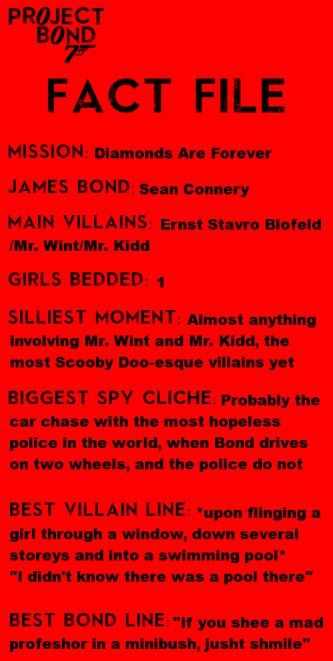 Bond, yet he looks a good deal older now. This seems to suit the character, though, and I believe he is an older chap in the original books (yes, there are books, apparently. I can’t imagine that working well, but there you go).
I’d like to first of all clarify that I enjoyed this film very much, probably more than any of the other Bond films so far. Despite what I felt was an over-reliance on Blofeld in places (played now by a third actor in as many films, and no longer bald), Diamonds Are Forever is a more unique and more self-contained story than any of the others, with the exception of Goldfinger.
Speaking of which, Goldfinger director Guy Hamilton returns, and you couldn’t pick a more tonally different film. I’ve had cause before to liken Bond to the Adam West Batman series, but never more so than with Diamonds Are Forever. Some of the villains in this film almost make Cesar Romero look like Heath Ledger, so cartoony are they, and some of the close-ups are so on the nose, you might as well have a narrator highlight key aspects to look out for before each scene begins, and recap it afterwards. It’s very, very silly, and not always in a good way.
The fight scenes in particular were quite an experience. The film being made before special effects were anywhere near as good as they are now accounts for some of the silliness of the fights, but no amount of CGI can improve a man pulling a mousetrap out of another’s jacket, a look of disproportionate agony on his face.
That being said, I thought the storyline was great, and quite different from those that had gone before it. This is probably Connery’s best performance as Bond, and Charles Gray is a pretty good Blofeld, in a very different way from Donald Pleasence.
After a brief reprieve, we must now say goodbye to Sean Connery, who, when asked to return for one more film, said, “Never again.”
Project Bond: On Her Majesty’s Secret Service
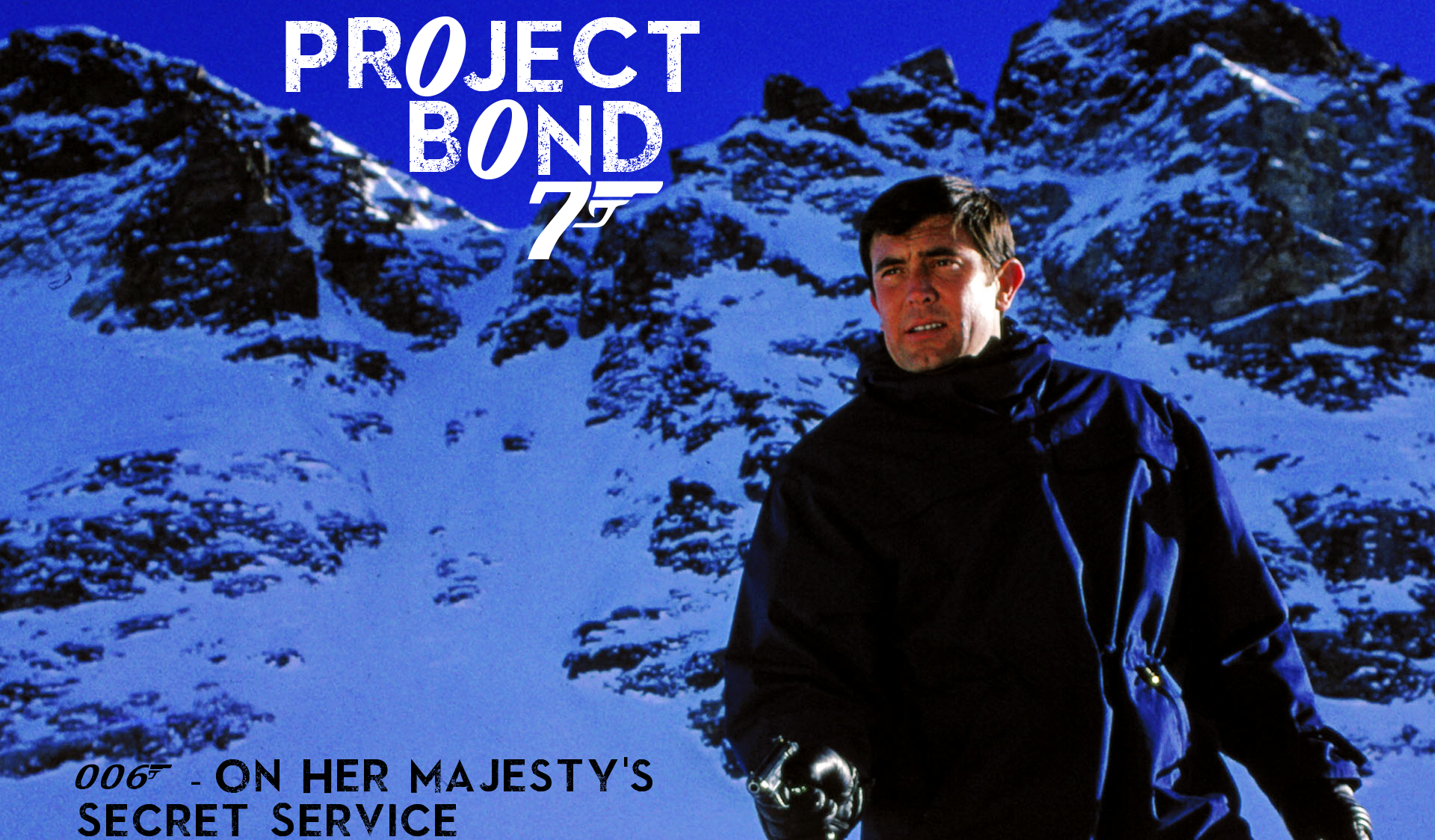
George Lazenby takes the wheel of the famous Aston Martin for this adventure, after Sean Connery decided he’d had enough, presumably while attempting to pronounce the title of the sixth film.
Lazenby’s task is a considerable one; Connery’s Bond had perhaps not taken on the level of iconicity that he has since, but to many people Connery was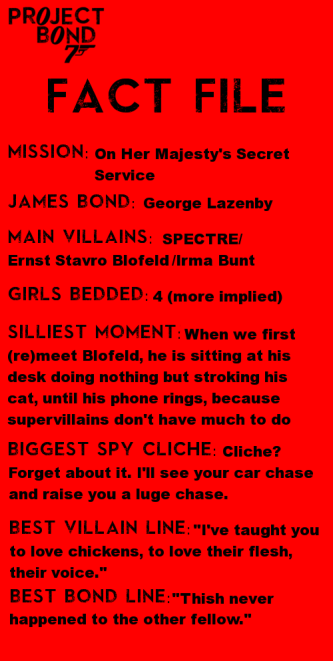 Bond, this being the first change of lead actor in the series. I thought that Lazenby struck a good balance: not quite imitating Connery, but not distancing himself too much from his predecessor’s interpretation. He affects a decent English accent, although his Australian brogue peeks through at times, while at other times it almost sounds as though he is trying a Connery impression. He is just as charming as Connery was, a little less sleazy, perhaps a bit calmer, and less well-furnished in the eyebrow department. There are very few nods to the casting change in the film, but I was amused to see Lazenby’s Bond wearing a kilt in several scenes, which Connery’s never did.
While Lazenby gets pass marks as Bond, Telly Savalas was far less chilling as Blofeld than was Donald Pleasence before him. There is a very odd scene in which Bond and Blofeld are both pretending to be other people, neither acknowledging that they recognise the other, which was compounded by both being played by different actors from the previous film. This is also the first film in which Bond goes properly undercover (he half-heartedly used an alias in You Only Live Twice when he was supposed to be dead), which is strange considering that it is such a staple of spy stories, and I’m now six films into the series.
Although there is less of it than in previous films, this one still features a hefty dollop of sexism and outdated gender roles. At the end of the film, Moneypenny is forced to watch Bond marry another woman, and through a series of close-ups of her face, we are meant to feel her sadness. Bond has messed her around for years, promising dates that never materialise, and she has been in awe of him throughout, waiting until he finally deems her worth spending time with. At a certain point, she would surely have had enough of that and looked elsewhere.
Overall, I thought this was a pretty good film, with a structure that seemed a lot less formulaic than the last few instalments. Lazenby is a good Bond without being excellent, and although his not being Connery is distracting from the plot, this is hardly his fault. While I enjoyed his take on the role, I must admit I’m looking forward to Shir Sean’s Lasht Hurrah (or is it?)…
Project Bond: You Only Live Twice
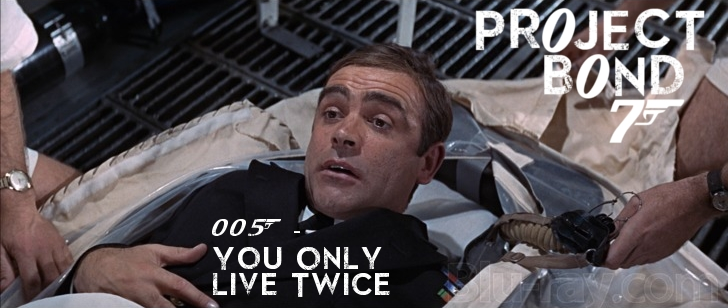
The last film in the series before Connery took the huff, You Only Live Twice is one of the most iconic Bond films, featuring the first full appearance of Ernst Stavro Blofeld, one of the most recognisable and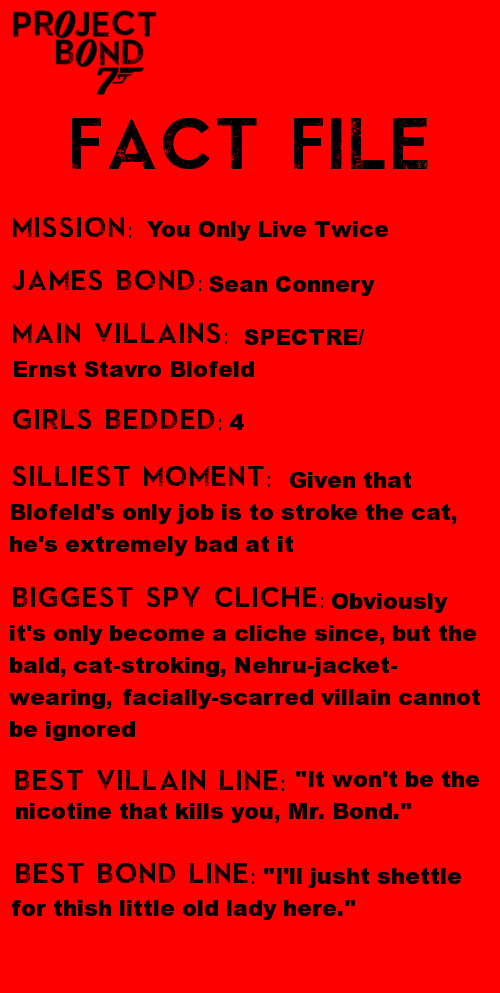 most parodied aspects of the franchise.
The title refers to Bond’s faked death at the beginning of the film, which appears to serve no real narrative purpose at all. A few people briefly believe that Bond is dead, and also that all other MI6 agents are so totally incompetent that they can now go about their schemes in broad daylight, at least until Bond reappears shortly afterwards.
Being set largely in Japan, there is naturally a huge amount of scope for people being flung comically through paper walls, and taking pratfalls over low furniture, during fight scenes. These were among the higher-brow segments of the film, with the plot being nothing terribly remarkable. I found the white-wearing ninjas very easy to spot, and I quickly tired of all the double/triple/quadruple agent women – a plot device that’s becoming very overused – but I did enjoy the helicopter scenes, of which there were many.
While I was underwhelmed by some aspects of this film, Donald Pleasence as Blofeld was a real highlight, rightly making this one of the most famous films in the series, and a fitting end to Connery’s (first) tenure in the lead role.
Project Bond: Thunderball

I found this instalment rather pedestrian compared to the two that preceded it. It takes quite a while to get going, and even then, it didn’t really have the same impact as From Russia With Love or Goldfinger.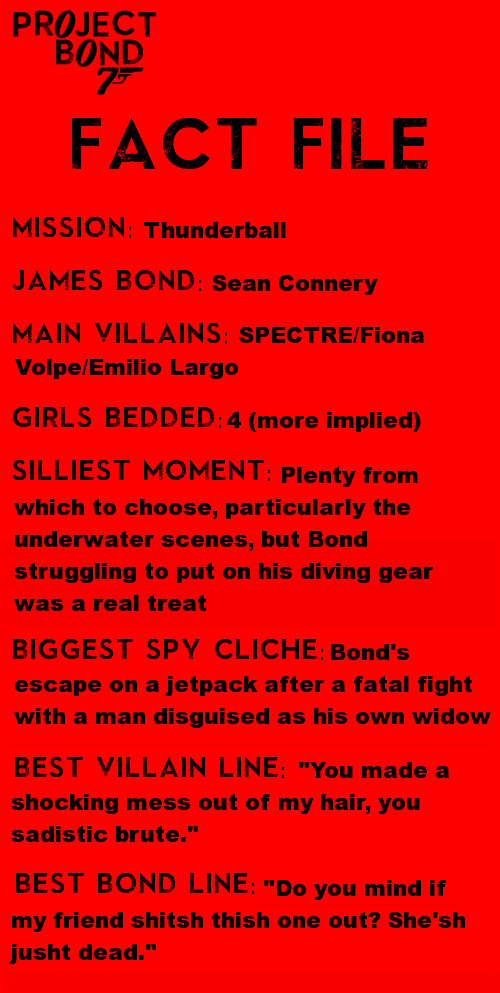
Nevertheless, there were some memorable moments, like your man with the eyepatch giving his daft hypocritical speeches, and his swimming pool full of wee sharks, which looked all too easy to fall into. Presumably he’d taken the necessary precautions, like putting out those wee blue bags you put over your shoes, and investing in a “no running, bombing or heavy petting” sign.
At no stage does Bond seem perturbed by not knowing who was on whose side, and goes on a mad shagging rampage throughout the film. A real highlight was the heart-warming scene in which Bond blackmails a woman into having sex with him under threat of losing her job for something that wasn’t her fault. Classic British values.
While the middle part of Thunderball is entertaining enough, the beginning and ending are both too long and don’t have enough going on in them. There are also several lengthy underwater sequences that seem to serve little purpose and are very difficult to follow. It’s okay overall, but I felt it lacked the structure of Goldfinger and the intricacy of From Russia With Love.
Project Bond: Goldfinger
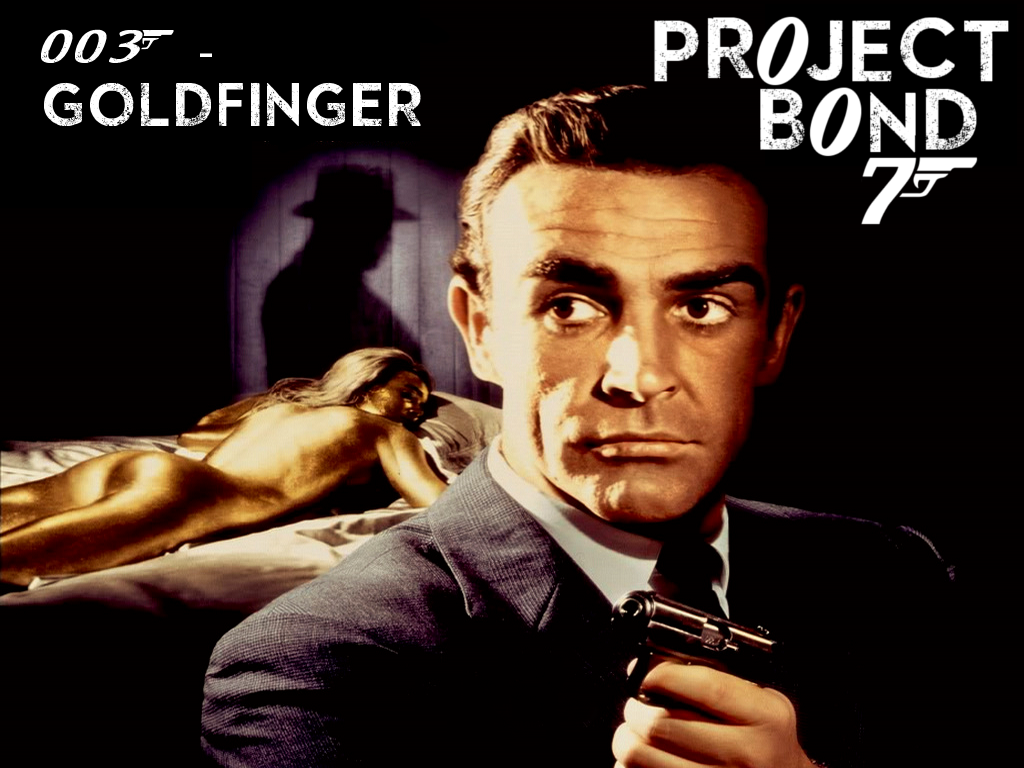
I’m not sure if these films are getting sillier, or if I’m just getting older, but this one felt pretty silly to me. This isn’t necessarily a bad thing, I’d just like to know what to expect. I thought the world’s suavest spy would be a bit more serious, but he keeps blundering into situations that lead to his being knocked out, much as I presumably would. His recoveries are a smidge more spectacular, though, I must admit.
Pussy Galore makes her infamous appearance as the most on the nose Bond Girl yet, working for your man Goldfinger, the man with the midas touch (except when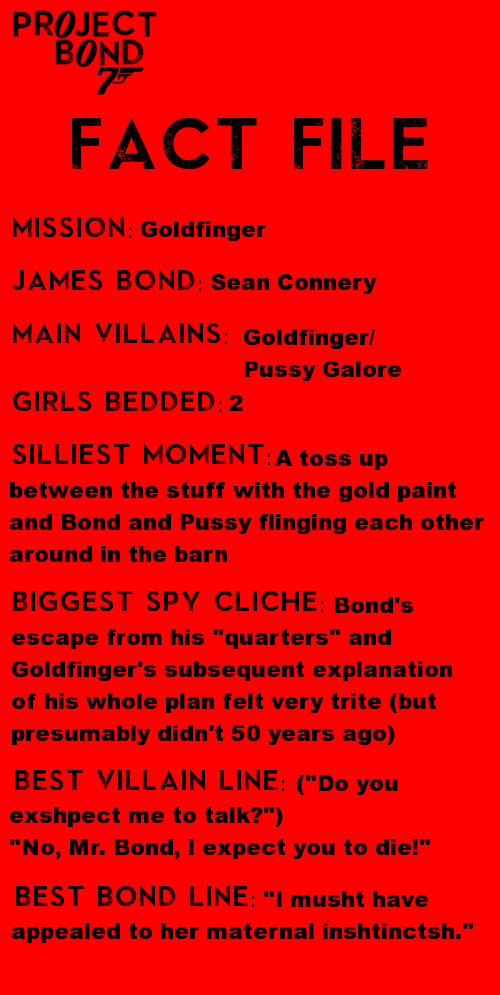 it comes to golf). Bond outsmarts him on the links, but rather than quitting while ahead, follows him to the land of the Switz, where he lands himself in yet more hot water.
One almost fatal encounter with a laser later, Bond is on his way back to America, in a plane piloted by Pussy, who seems quite unaware that to fire a gun in the cabin would be a bad move. Things look bleak for Bond, especially since the two chaps assigned to keep an eye on him don’t seem to be up to much, assuming that he’d get in touch if he were in any trouble. However, the day ends up being saved, with Bond taking full credit, when only part is really due, and all’s well that ends well.
As ever, we can just skip over the casual misogyny and even more casual racism. Goldfinger’s Korean caricature manservant, Oddjob, isn’t meant to be offensive, it’s just a laugh! A funny joke, like on Top Gear, designed to cause harmless mirth AND weed out the PC Brigade at the same time. Classic British values. Look at his hat! Just like all Koreans, Oddjob has a razor-sharp top hat, with which he very deftly decapitates people and statues alike. Lovely stuff.
Goldfinger is a rather comical villain, who might feel more at home in Adam West’s Batman, without any clear motivation other than greed. That’s not to say that the film isn’t enjoyable, but I did find my disbelief being suspended further and further, now that I know exactly what to expect.
Project Bond: From Russia With Love

This is a bit more like the sort of thing I was expecting. The long title sequence was preceded by an action scene, whereas Dr. No started very slowly. After a decent start, though, I thought From Russia With Love suffered from a very unsubtle scene explaining the background and spoiling a lot of the plot that was to follow.
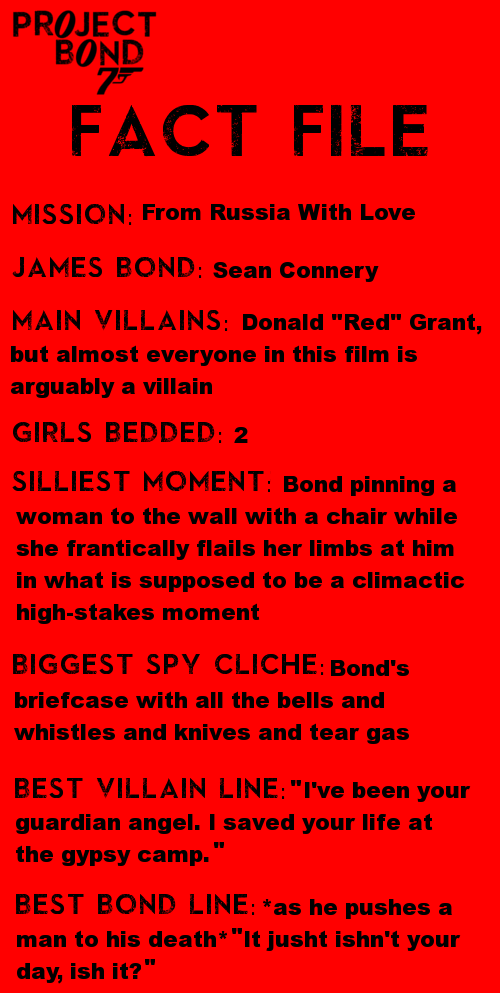 However, the film picks up a bit, because then we cut to James Bond (and, yes, he’s with a lady!), but he is quickly ordered back to heidquarters (but not too quickly, if you take my meaning). He is then sent off on a wacky mission to track down a Russian woman who has been enchanted by his picture and has offered some spy equipment in exchange for some sex, so there’s definitely no time to lose in stopping to think about how dodgy this might be.
Matters are further complicated when it turns out that a number of different groups are after our hero, and, what’s more, they will stop at nothing to get their paws on him, for reasons that need not be fully explained. There are some people who are probably on Bond’s side, who will inevitably be killed or elsehow rendered useless, and some of whom we’re never quite sure. Bond seems to know what’s going on some of the time; at other times, he’s in a world of his own. I’ll say this for him: he’s relatable.
Anyway, I digress. Various confrontations ensue (some on trains, some not on trains), with sexy results, and all’s well that ends well. This seemed a more thorough story than Dr. No, was quite a bit sillier in places, and overall was a more entertaining film, in my opinion. I think I can say with some confidence that this is my very favourite of the James Bond films that I have seen.
State of the Union
In September last year, when the people of Scotland voted 55-45 against independence from the UK, I was staggered at how many commentators seemed to believe that would be the end of the discussion. “Well, it’s official,” said Conservative, Labour, Liberal Democrat and other Better Together supporters, “the people of Scotland have chosen to stay in the union. Nothing more to be said.” Eight months later, they are astonished that Scots want to have a say in how this union should be run. Not only that, but some of them still seem to be in favour of this ‘independence’ idea that scraped a paltry 45% of the vote in the referendum. It was outrageous, it was anti-democratic, the electoral system would have to be changed. These cries have of course now vanished from the London-run media since the first-past-the-post system has delivered what it is designed to: a Tory majority. As disappointing as the overall result is for 85% of Scots, the vote in Scotland told a fascinating and radically different story.

Project Bond: Dr. No

My first visit to the world of Bond was 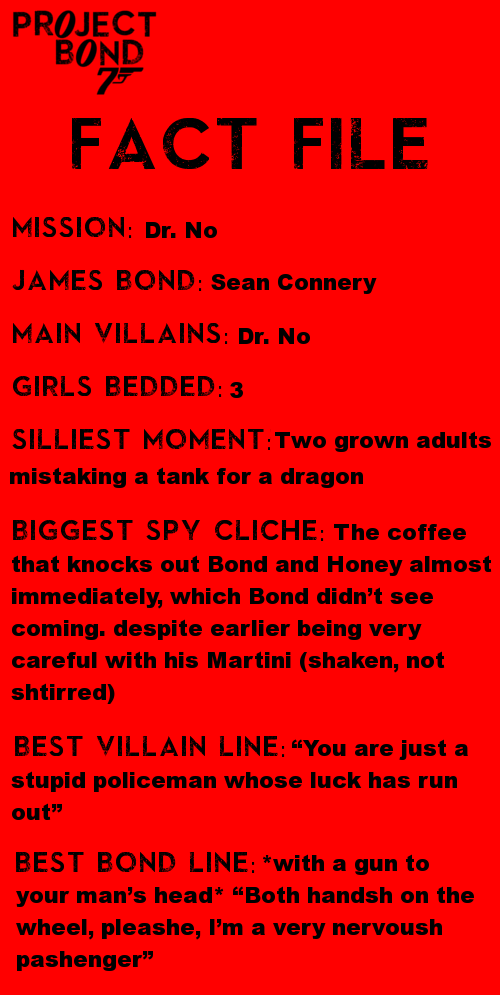 a tad underwhelming. The storyline wasn’t particularly exciting, and the introduction of the central character (James Bond) felt a little flat.
Of course, at this stage the producers would not have been anticipating the film starting a multi-million pound 50-year international franchise, so the lack of fanfare is understandable. Still, I thought it could have been a bit more grand, but I suspect that will come in the following films.
It seemed a bit less formulaic than I was expecting (again, something that may well change as my project continues), and there was a little more conversation, a little less action than I had anticipated. The film must also lose points for not featuring a “Dr. No Hands” line, which was very disappointing.
Project Bond

If you had just met me, you would of course be curious, and you would naturally ask somebody who knows me really well for a bit more information about me. And they’d likely say, “Oh, Colm? Yeah, he’s great. He’s known for his flawless impression of Sean Connery, his love of and expertise on comedy, his ability to come up with snappy and clever blog titles, and the fact that he’s never seen a James Bond film.”
You’d then reply, “Really? He’s never seen a James Bond film? Well, that just makes the first titbit you gave me all the more impressive.”
“Doesn’t it?” that person would say, before going on to list some more of my excellent impressions. If I were there, I’d stop them due to humility or whatever, but I’m not, you’ve asked about me on the sly, so I am powerless to intervene.
Anyway, yes, it’s true, I have never seen a James Bond film. It seems like something I should have done by now, because I like spy stories (not as much as detective stories and heists and capers, but still). Given that I’m almost 25, I decided it was time to address this issue, not least because there are 25 James Bond films and I love daft things like that. So, between now and my 25th birthday, I’m going to watch all of the James Bond films, and let you know what I thought of each one, from Dr. No up to Skyfall, and the two non-official Bond films, Casino Royale (the David Niven version), and Never Say Never Again. I was thinking of doing one each day for the 25 days before I turn 25, but I thought that might get in the way of other things, like my having a life, so I’m loosening up the schedule a bit.
I don’t really have anything else to add right now, because I haven’t started yet. Watch this space for my opinbonds (hey, there you go! Now we’re advancing rapidly).
Seven Reasons This Semi-Obscure Queen Album Track Is Better Than The Robbie Williams Hit Of The Same Name
1. Mental lyrics
The lyrics to this song are pretty ridiculous, even by Queen’s standards. They somehow managed to include phrases like “grounds for divorce,” “rock a la carte,” and “pleasure chest,” and use “Cruella de Vil” as a verb. It must be heard to be believed.
2. Self-referential
They make various references to themselves and their career, including their US and UK record labels (Elektra and EMI), as the song is essentially about them preparing for a gig, and warning that it’s going to be phenomenal (which it almost certainly was). They suggest going to their tour manager, [Gerry] Stickells, if you are in need of a fix or a high, and offer/threaten to “sing to you in Japanese.”
3. Mental rhymes
“But Freddie, nothing rhymes with Japanese.”
“Nothing, except ‘Breakfast at Tiffany’s’.”
”But Freddie, that still doesn’t really rhyme, and it doesn’t make any sense.”
These are certainly valid concerns, but if you sing it with enough power and confidence, it doesn’t matter at all. See Exhibit A, above.

Image: Neal Preston/theredlist.com
4. Mental music
The guitar riff that kicks in at around 15 seconds is one of my very favourites, and there’s some top drumming in there as well. The lyrics are what make this song, but without the music underneath, it would just be a pretty strange poem. This song is typical of what made Queen great in the 70s, and exactly the kind of thing they more or less stopped doing after ‘The Game.’
5. They don’t take themselves too seriously
A lot of Queen’s music (particularly in the 70s) is quite silly as well as being quite brilliant at the same time. This song is a prime example, as is ‘Tie Your Mother Down,’ which originally came from a line Brian sang just to demonstrate the riff, and Freddie insisted that it had to become the song. Despite the silliness of the lyrics, both of these are punchy hard rock tunes. There are plenty more tracks you could point to (especially on their first four albums) that have some pretty odd words to them, but this doesn’t subtract anything at all from the enjoyment, and arguably adds a couple of levels.
6. They delivered on it
They sure did entertain us. Queen remain among the top-selling artists of all time, despite not really having released anything new in 20 years, and their Live Aid performance is one of the most famous in musical history, for good reason. Not everything they did was for everyone, but we all have at least two or three Queen songs that we like. (And if you tell me otherwise, I won’t believe you, so don’t bother lying to me.)
7. It gets better every time you hear it
When I first bought the album in 2004, I was rather disappointed to learn that it was not in fact the original version of a song later made famous by Robbie Williams. Several hundred listens later, though, and I much prefer this song. For me, it’s a far better anthem for Queen than ‘We Will Rock You,’ although that may be due to WWRY being one of the most overplayed songs in existence (but still a great song). I get the impression that the band were hoping it would take off, and they could open all future shows with it, but for some reason it’s not one of their more popular songs (probably because it was never released as a single).
I listened to it on my big headphones for the first time very recently, and it sounded incredible. It benefits from repeated listens, which is true of plenty of songs, but not all, and I think it applies to this song more than most.
Plus, they did it all with no synthesisers. Badass.
 Colm Currie
