Colm Currie
Writing things so you don't have to
Project Bond: GoldenEye
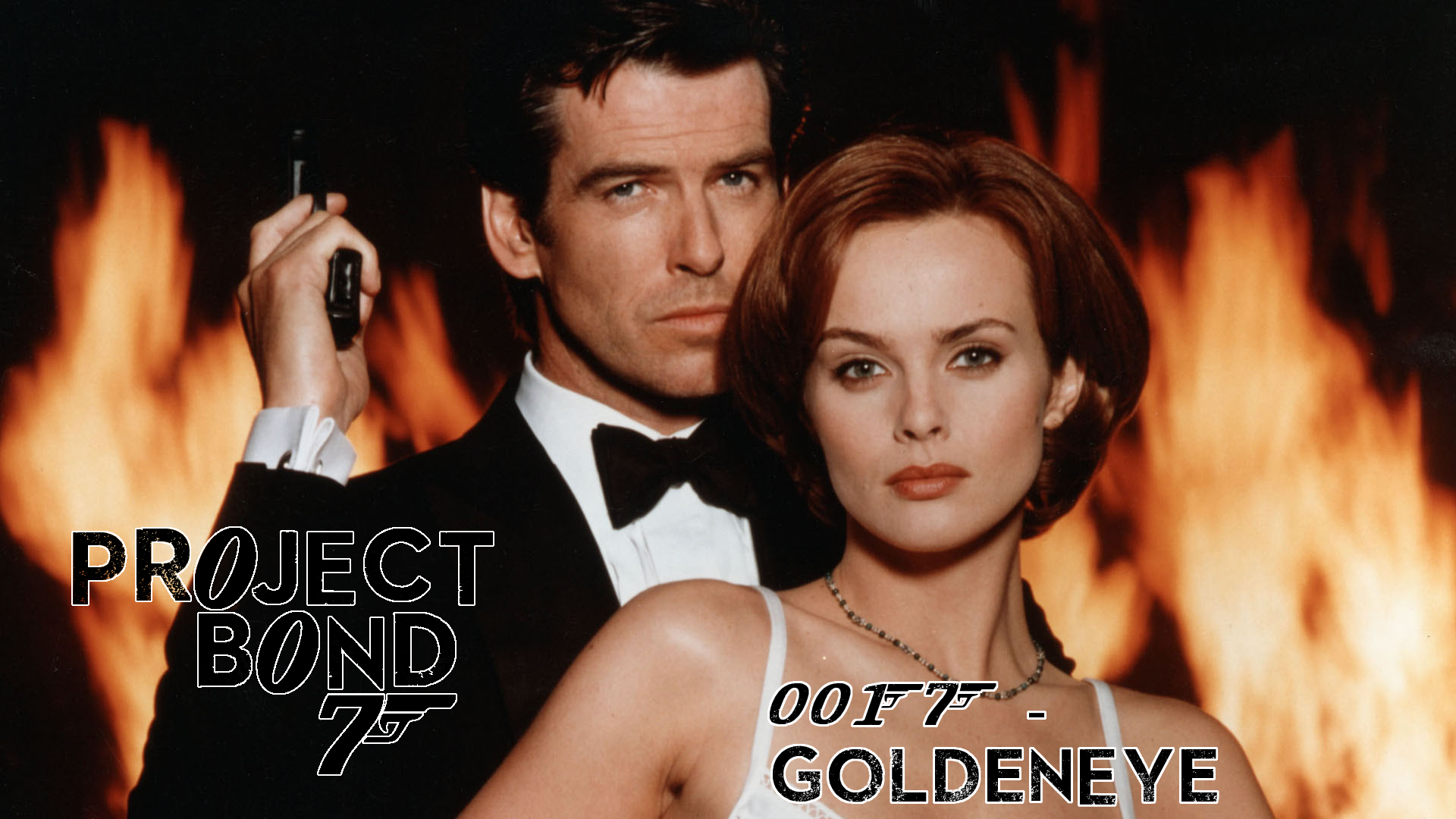
Another film, another new actor. Timothy Dalton’s two-film reign as Bond came to an end after a copyright dispute caused a six-year gap between two films, the longest yet in the Bond franchise. By the time they were ready to make another, Dalton’s contract had expired, and he did not want to continue in the role. The lead was then offered to Pierce Brosnan, who had been considered before, and indeed offered the job ahead of Dalton last time. My first impression: he’s not bad at all.
The delay in starting this film seems to have prompted some major changes behind the scenes, with some updates to the MI6 office, and a more modern feel to the film overall, with CGI used for the first time. The role of M has been recast, with Judi Dench taking over, and one of her first acts is to call Bond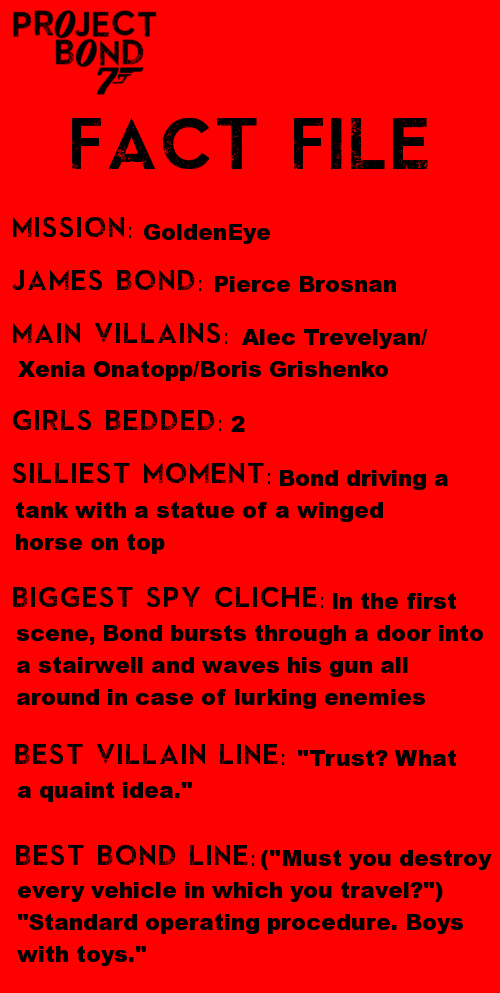 on his misogynistic bullshit. Moneypenny, now played by Samantha Bond, also has a word with him about his stringing her along, so it was nice of the series to move into the 20th century just as the rest of us were preparing to leave it. This film also offers our first view of post-Cold War Bond, so there might be a reduction in the over-the-top Russian accents and stereotypes (although not if Robbie Coltrane and Alan Cumming have anything to say about it).
The film opens with Bond and his best pal Alec Trevelyan (AKA 006, AKA Sean Bean) being captured by some Russians. Trevelyan tells Bond to get out of there and blow the place up, which had been the plan all along, although he hadn’t bargained on killing his best pal. Still, his loyalty is to the mission, not his pals, so off he goes. Nine years later, though, he’s still awfy sad about it, so M cheers him up by sending him off to investigate Xenia Onatopp of the Janus crime syndicate.
Skip to the middle: turns out Sean Bean is still alive, which was hardly a surprise, even though he dies in everything; he’s too big a deal to die before the opening credits. He was mega angry because Britain killed his mum and dad, so he faked his death and formed a crime syndicate to rob the Bank of England.
There follows some pretty decent action stuff, including a tank chase, shot-down helicopters, and a big burning train. Bond eventually gets the better of his old pal by dropping him a few hundred feet into a satellite dish, where he dies again.
I quite liked this one; Brosnan did a decent job, and Sean Bean is always good value. Plot-wise, it was nice to see real world events taken into account, and a bit of modernisation as well. This is, for obvious reasons, the best-looking of the Bond films so far, and I expect further improvements will follow.
Project Bond: Licence To Kill

James Bond is back, and this time, it’s personal. Like last time, and some of the other times, but a bit more so. His good friend and CIA ally, Felix Leiter, has been badly maimed (by a shark, of course), and his wife of a few days murdered. Bond swears revenge on Sanchez, the drug lord responsible (and his henchpersons, including a young and almost unrecognisable Benicio del Toro), even if this comes at the expense of his job, which it does, obviously. He gets even madder when Leiter’s pal Sharkey is killed by a shark, which he should really have seen coming.
M has flown out to berate him in the jungle, because phones haven’t been invented yet, and tells him to forget about Sanchez and get back to whatever he was supposed to be doing. Bond resigns, and M revokes his licence to kill (nudge nudge) and demands his weapon (gun). Bond sticks t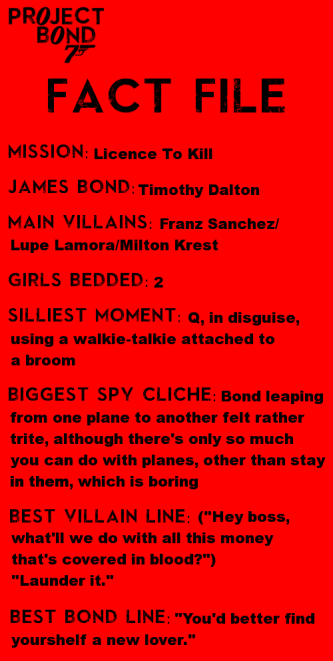 he nut in him and runs off with his weapon (gun), determined to avenge his friends. This doesn’t stop Q helping him out later with some gadgets and exasperated sass, for some reason.
Bond is getting on well with two ladies, Pam Bouvier and Loupe Lamora (or ‘Sane Today,’ as I call her), from opposite sides, for strictly professional reasons, of course. This inevitably blows up in his pointy face when one sees him with the other, but he eventually smoothes things over and is able to play Sanchez and the CIA against each other to his own ends.
So Sanchez thinks Bond is brand new, and Bouvier thinks he is on her side, which he essentially is, but he wants to kill Sanchez, not lock him up. Meanwhile, Sanchez is distracted by trying to sell hunners of cocaine to some “Orientals,” and doesn’t pay enough attention to Bond. Only Benicio del Toro suspects something, and he gets his when he is chewed up by a big shredder.
There follows a very impressive chase scene with a lot of fire and petrol, which reminded me of the good bit in Die Hard 2: Die Harder, although Licence To Kill came first. Sanchez finally corners Bond, having realised that they’re not exactly best pals after all, and it all looks grim for our hero, until he pulls The Ol’ Switcheroo and burns Sanchez to a wee crisp. It’s quite something.
I didn’t enjoy this one as much as Dalton’s previous outing, but it was still pretty good, and I’m going to miss him when he’s gone, which is now.
Project Bond: The Living Daylights
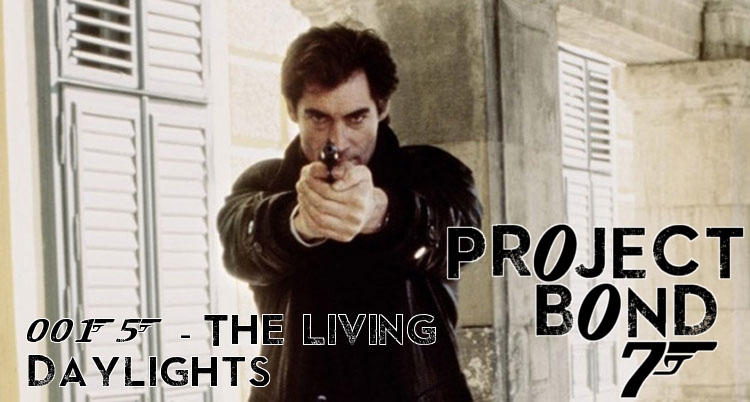
Well, well, well. What have we here? Timothy Dalton, you dark horse, you. This was an unexpected pleasure. I’m not sure if I was just so utterly sick of Roger Moore, or if Dalton was genuinely brilliant, but this was one of my favourite Bond films so far.
After Moore was sacked or quit, depending on whose account of the situation you believe, a lengthy and complex casting process ended up with Dalton taking over the role of James Bond. Immediately he puts his own stamp on the character, appearing much more suave and much more threatening than Moore (or even Connery, for the most part) did. His first assignment is to kill Kara Milovy, rumoured KGB sniper and confirmed orchestra cellist, who is attempting to shoot a KGB defector. He does not shoot to kill, however, instead knocking the gun from her hand. His ally, Saunders, threatens to grass him up to M for not following orders, and Bond does not seem at all bothered whether or not he keeps his job. This is a Bond who does not care, a Bond with little to lose, a dangerous Bond.
M does not fire Bond, but does reprimand him for acting on instinct, rather than orders. Already, Dalton has conveyed more emotion and more of a personality than his predecessor. He does not have Connery’s eyebrows, but he does have a disdainful look of which Liz Lemon would be proud, and of which Moore could only dream. He stands up to M when threatened with forced leave, and insists on finishing the mission himself, although he does so by going somewhat rogue, pursuing Kara, convinced that she is not a killer, and can help him. She can and does, but her allegiance is often unclear to the audience, as with most characters in this intricate instalment.
Dalton’s Bond is a bit more driven, a bit darker, a bit more determined, whereas Moore just did what he was told most of the time. He is willing to go a bit further to get results, not afraid to put a gun in John Rhys-Davies’s face after tying up his ladyfriend. He’s also a very snappy dresser, something that is true of his predecessors but to a lesser extent, although the knot in his tie is conspicuously small. The brooding, menacing vibe of this Bond does not go especially well with the hint of a Welsh accent, but Dalton pulls it off superbly.
This film combines a lot of the best elements of Bond so far, with more genuine espionage work than we’ve seen for some time, high stakes, unsteady alliances, delicately balanced conspiracies, and a much darker, more interesting lead character. I found the conclusion slightly too long and more reminiscent of Moore’s day than I’d like, but overall this was an excellent effort, and I am already disappointed that Dalton’s Bond only lived twice.
Project Bond: A View To A Kill

I was quite ready to say goodbye to Roger Moore, you’ll be surprised to learn, but I would not be allowed to do so before being subjected to another pointless skiing scene. This one, before the opening credits, has nothing to do with the plot of the film, and I’m fairly sure they’re just trying to annoy me now.
It turns out that this bloke Zorin has been fixing horse races with microchips that he nicked off MI6, so Bond has to go after him. He’s trying to get information out of another lad, Aubergine, when the latter is shot and killed with a dart fired by May Day, Zorin’s henchwoman, or henchperson. Bond chases after her, and ends up driving the front half of a car onto a bridge before jumping off it, onto a boat, in hot pursuit, but to no avail.
This instalment is a bit more like the spy stories of old, with more actual spying and a fair bit of double-crossing and the like. It’s also a bit strange in that there are recognisable people in it (Christopher Walken is Zorin, and Grace Jones is May Day). The story is nothing too special, and there are plenty of the cliches that are typical of Moore’s era, and the later part of Connery’s, but it’s one of the better films with Moore in the role, with a couple of decent villains and a less ridiculous script. It ends, as you might expect, with a blimp crashing into the Golden Gate Bridge, with sexy results.
I preferred this film to any of the previous three, or perhaps even four, and I definitely noticed an improvement in Moore throughout his tenure, but I certainly won’t be sorry to see the back of him.
Project Bond: Octopussy
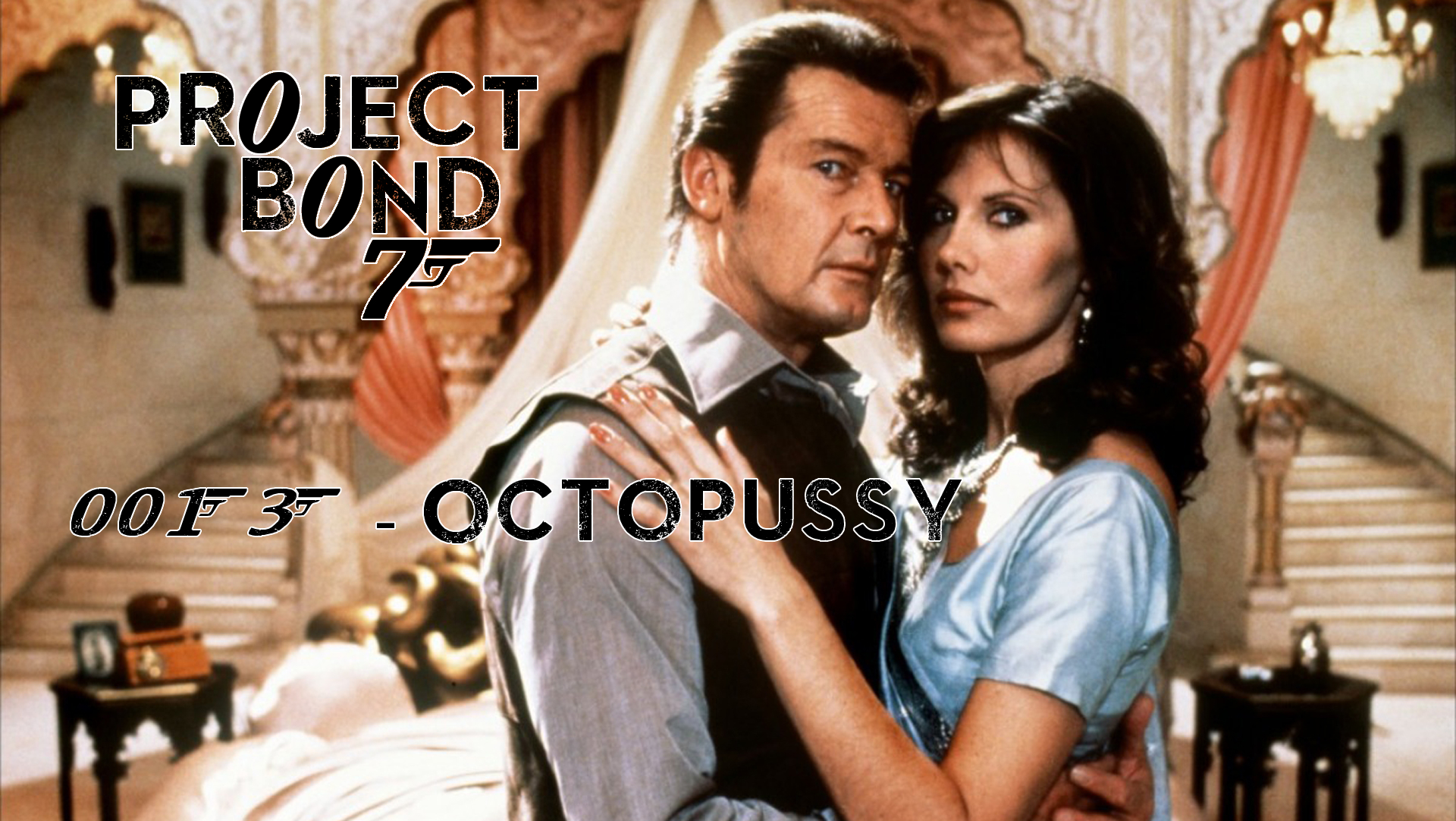
We open on Bond wearing a false moustache and dressed like a communist at a show-jumping event, where there is an unnamed bearded cigar-smoking chap dressed like a communist. Bond and his obligatory female companion shoot out the tyres of an army truck that crashes into a chicken coop, for some reason. The “end of the beginning,” if you will, sees Bond escape in a small plane that was hidden under a false horse’s arse in a false horsebox. Most ingenious, I’m sure you will agree.
The next 00 agent we meet is 009, dressed as a clown running through some woodland in East Berlin, which was still a thing then. He is chased and killed, meaning that 007 (Bond, James Bond) has to go to Sotheby’s and bid on a Fabergé egg, but he doesn’t really want it because he swapped it with a fake 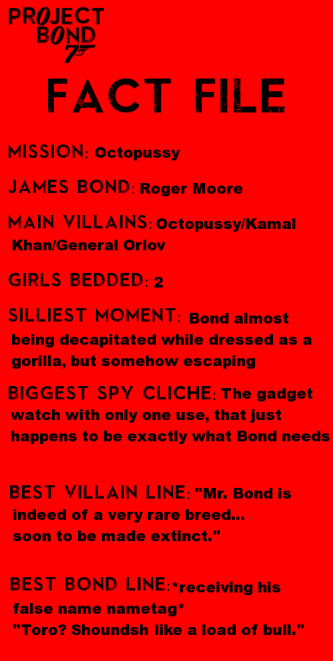 one, so now he’s got the real one, which he uses to fund his backgammon habit, but first travels to India so his boss won’t find out. As luck would have it, while there he encounters a bad guy, Kamal Khan, and hustles him at backgammon, but in so doing is forced to reveal the Fabergé egg in his possession.
Khan comes after Bond and takes the egg back, and Bond works together with a woman named Octopussy and a snake charmer who plays the Bond theme on his wee flute to get it back. However, he soon finds he has bigger fish to fry because it turns out the Russians (boo) are planning to set off a dirty great bomb! Worse still, they’ll make it look like it came from the USA! Bond is left with no choice but to infiltrate the circus. Dressed just like 009 was at the time of his death, 007 successfully defuses the bomb with around a second to spare. You can tell this because the bomb has a digital display counting down to the exact moment it will explode, like all bombs do.
It’s not over, though, because there’s still the problem of Khan (from before, remember?) to deal with. Bond ends up having a fight with Khan’s henchman on top of a plane, which is in the sky. Khan’s man should win because he has a knife, whose power he extrapolates by shouting “Hiya!” with every stroke of Bond’s face, but Bond gets hold of the plane’s radio aerial and pings it back into the guy’s face, the force of which inevitably knocks him to his death, and Blighty triumphs yet again. Huzzah!
This effort definitely has a bit more direction and a less confusing plot than the two before it, but it’s still a good bit behind even Moore’s first two films, and around the level of The Spy Who Loved Me. Only one to go now.
Project Bond: For Your Eyes Only
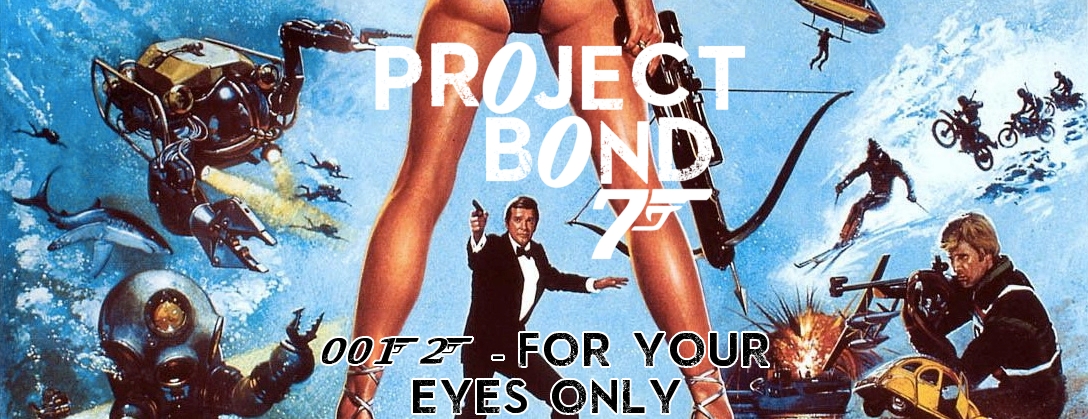
The tone was set early on with an opening scene that definitely does not feature Ernst Stavro Blofeld. It does, however, feature a bald villain in a wheelchair with a white cat, and he doesn’t relate to the plot of the rest of the film at all. (For copyright reasons, Blofeld and SPECTRE could no longer appear in Eon Bond films.) He tries to kill Bond, but this backfires when Bond drops him down a chimney, possibly to his death, possibly who cares?
A toe-curlingly embarrassing opening now behind us, we can move on to the main “plot.” There’s a submarine that’s gone missing, and so the government tells MI6 to tell Bond to see what’s going on. You know the sort of thing.
Once again, Bond is captured, once again he is rescued, once again it is by a woman, and once again he is astonished at this ‘twist.’ A woman, doing things? This is unheard of! Apart from the last 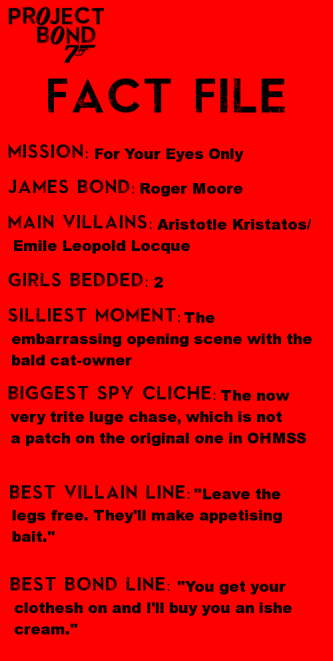 time a woman saved me, and the time before that. And the time before that.
This time, the woman is Melina Havelock, who uses her car to run the escape mission after Bond’s is blown up for some reason. At one point, Melina tips the car over driving on a preposterously uneven road, so Bond takes over and drives her car safely and competently through a forest. I never knew how dreadful women were at driving before I started Project Bond, so it has taught me that, if nothing else.
Then after a skiing scene that lasts about 40 minutes for some reason, Bond gets into a fight on the ice with some hockey players. (I assume it’s in Moore’s contract that he has to ski in every film, because it doesn’t come up organically this often.) At this point, I stopped, wrote down exactly what I thought would happen in the second half of the film, and then watched it happen. That’s entertainment.
I really hoped that I would like Roger Moore by this point, but I just can’t. It doesn’t help that this script is extremely derivative of virtually all previous films in the series, but Moore remains extremely wooden, and his smile is still excruciating. His only saving grace is that he has a voice that is quite fun to imitate, but even on this front, Sean Connery triumphs hands down.
Project Bond: Moonraker
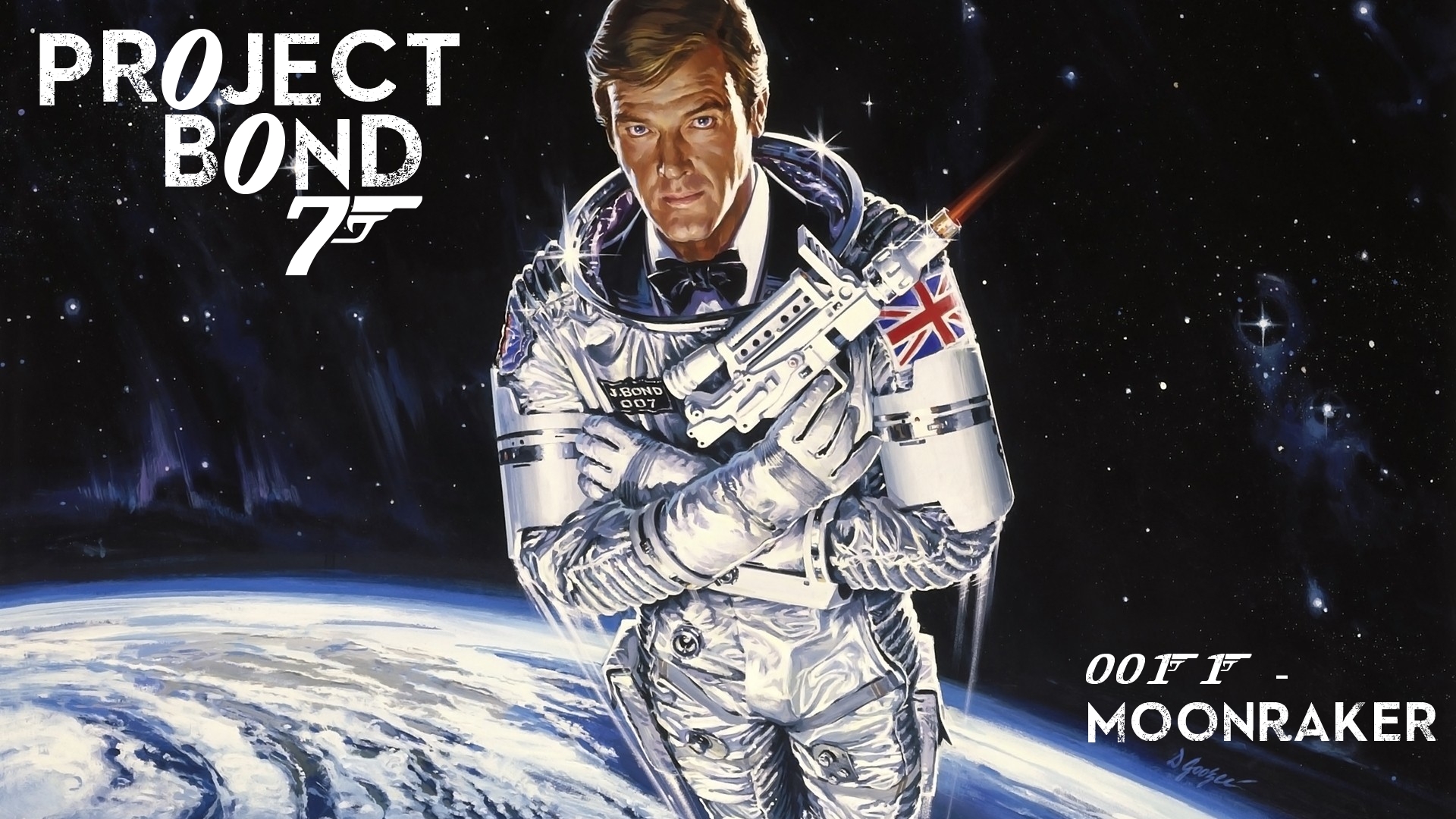
This film doesn’t mess around, opening as it does with Bond being abandoned on a doomed plane for some reason, until The Man With The Metal Mouth reappears for some reason and pushes him out, so Bond has to catch up with the chap who abandoned him for some reason (which is possible because of science reasons) and beat him up and take his parachute. Then The Man With The Metal Mouth catches up with Bond (using science) and they have a fight and Bond wins, but The Man With The Metal Mouth survives because he lands on a circus.
Meanwhile, this fellow Drax has one of his moonrakers disappear, and it’s awfy suspicious, so Bond is sent to speak to the poor, seemingly bereaved chap. Bond reckons that something is afoot, but M and Q tell him where to go. “Nothing wrong with Drax,” they tell 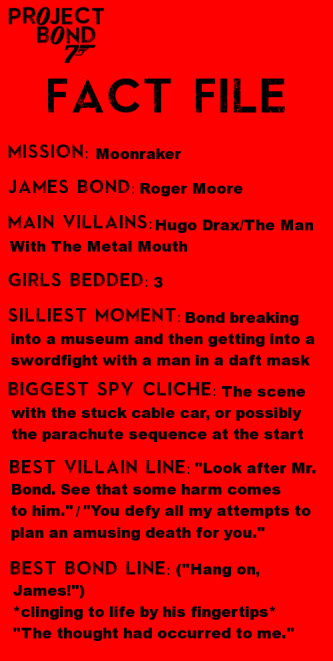 him, so Bond teams up with Dr. Goodhead (“No, that name’s not ridiculous, go for it!”), an undercover CIA agent formerly in Drax’s employ, to bring him down. But it turns out Venice won’t be any use, so they have to go to Rio de Janeiro. Obviously.
Roger Moore looks so uncomfortable wearing a massive poncho and riding a horse, that they might have been better off cutting the scene, even though it made a huge amount of sense. (They also play a piece of music that’s supposed to sound like The Magnificent Seven, but painfully isn’t.) Anyway, then it turns out that Bond was right all along, and Q and M end up with egg-splattered faces. Then The Man With The Metal Mouth starts chasing Bond while the pair of them are on speedboats, so Bond lures him towards a waterfall and makes good his escape on a hang-glider, as you do.
Oh no! A smirking Bond is dragged underwater (by a snake, no sharks this time), but then he kills it and everything is fine for a few seconds before The Man With The Metal Mouth turns up. Then we’re suddenly in space, bringing a Noah’s Ark of genetically brilliant humans into space to allow Drax to destroy the earth, where everyone lives. Seems a bit extreme to me, and Bond isn’t a fan either, so he puts a stop to it.
Then, in a shocking twist ending and a real departure from the norm, Bond saves the day and gets the girl and everyone else gets an eyeful. Lovely stuff.
This was a decent film, and certainly more PC than most previous efforts, Bond’s unconfined astonishment at Dr. Goodhead’s being a woman notwithstanding. There’s also a woman we are supposed to find as hideous as The Man With The Metal Mouth simply because she wears glasses and has her hair in pigtails, but you can’t have everything. Where would you keep it?
Project Bond: The Spy Who Loved Me
This might be Alan’s favourite, but I was pretty underwhelmed, it’s fair to say. There were a lot of familiar Bond elements (a reclusive hateful villain who is overly fond of sharks, a love interest of variable allegiance, so-bad-they’re-good one liners, a naked woman walking along the top of a gun, etc.), and very few new ideas, which showed.
Although it shares its title with one, this is the first Bond film not to be based directly on one of Ian Fleming’s books, so perhaps I was too quick to be dismissive of them in an earlier post. After some submarines 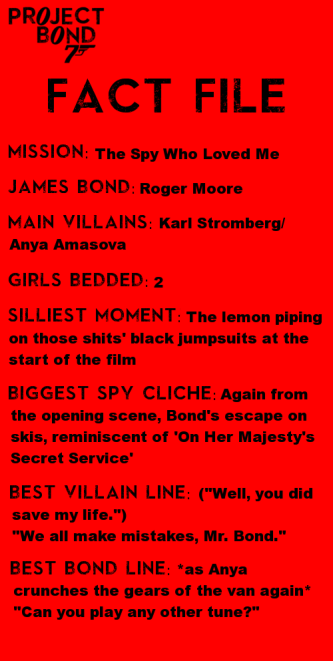 disappear, MI6 and the KGB put Bond and Amasova on the case together, with sexy results, particularly when Amasova learns that Bond killed her boyfriend (though, to be fair, he was shooting at him from a black jumpsuit with lemon piping). Anyway, they find out that this fella Stromberg has been nicking all the submarines.
To get close to your man, Bond poses as a marine biologist, but he is immediately seen through, and Stromberg sends after him a very tall chap with metal teeth.
There’s a fight in a scrapyard followed by a car chase followed by a fight on a train followed by some strategy meetings followed by a showdown at Stromberg’s base (which, just for a change, is underwater, rather than an island). Bond frees all the submariners taken prisoner, because the woman who has been his equal throughout is now a helpless hostage, whom he also has to rescue, obviously. He then programmes two of Stromberg’s vessels, which were intended to destroy New York and Moscow, to destroy each other instead, which was fairly rad. Then he saves the girl and there are loads of innuendos, so everything is fine once more. Classic British values.
Project Bond: The Man With The Golden Gun
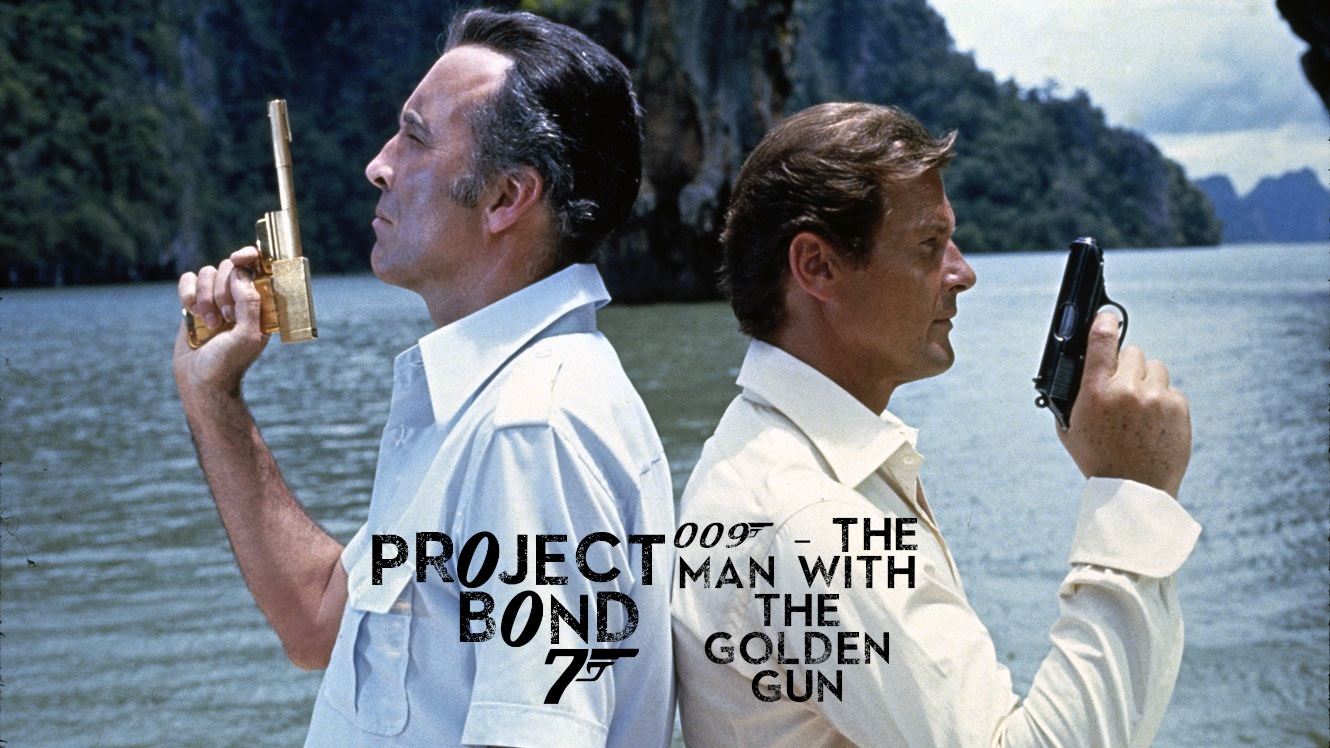
I much preferred this outing to Roger Moore’s debut, although that is less to do with the man himself than it is to down to the script and the quite simply villainous villain. Christopher Lee is quite simply splendid as Francisco Scaramanga, and there quite simply isn’t enough of him.
Moore continues to look as though he’s had half a dozen botox injections, showing absolutely no emotion during a scene in which he is told that 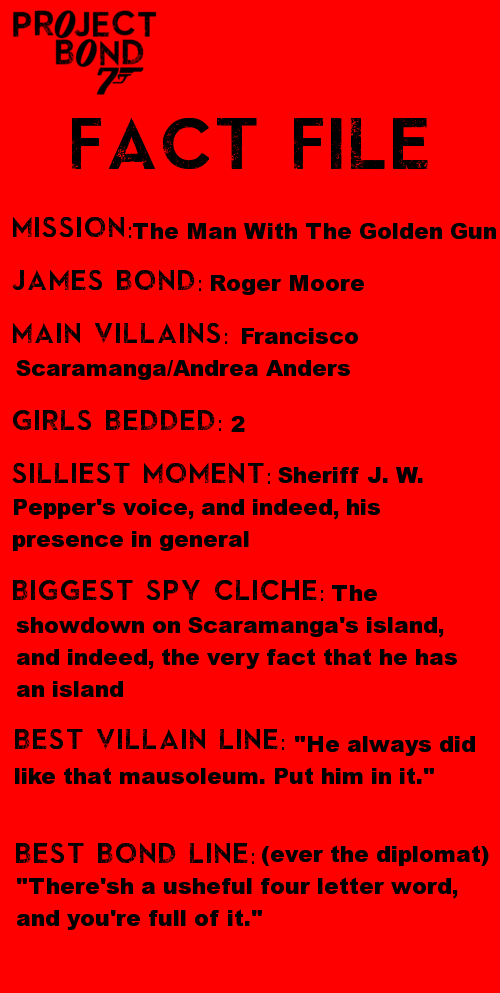 there is a man (with a golden gun, no less) plotting his demise, and that he (Bond) has been relieved of duty. On the occasions he attempts a smile, he looks as though he could do with some pointers from Ed Miliband. He could also use a couple of expressive eyebrows, like what Connery had, or even one would be a start.
Bond is not exactly a great role model, choosing to push a Thai boy into the river rather than pay him the money he promised. Shortly afterwards, J. W. Pepper turns up for absolutely no reason at all, and we learn that his wife addresses him by his initials. A fascinating and useful character insight that was not half as good as more screen time for Christopher Lee would have been.</sarcasm> J. W. also ends up in the river, but he called an elephant ugly, so unlike the wee laddie, he deserved it.
The scene in which Bond and Scaramanga sit down for dinner reminded me of a similar moment in Dr. No, a role for which Ian Fleming suggested Christopher Lee, incidentally. This segment contains the famous “You get as much pleasure out of killing as I do, so why not admit it?” exchange, which was tempting, but I selected a different best villain line, as you’ll see.
Scaramanga’s manservant, Nick Nack, is rather reminiscent of Oddjob, with a touch of the French stereotype about him, and rather a lot of fun poked at his dwarfism. Bond is still very aggressive with women, something that is excusable when they’re trying to kill him, which is often, but not always. However, it’s nice to see Moneypenny standing up for herself a bit more, apparently having had enough of his shit.
Project Bond: Live And Let Die
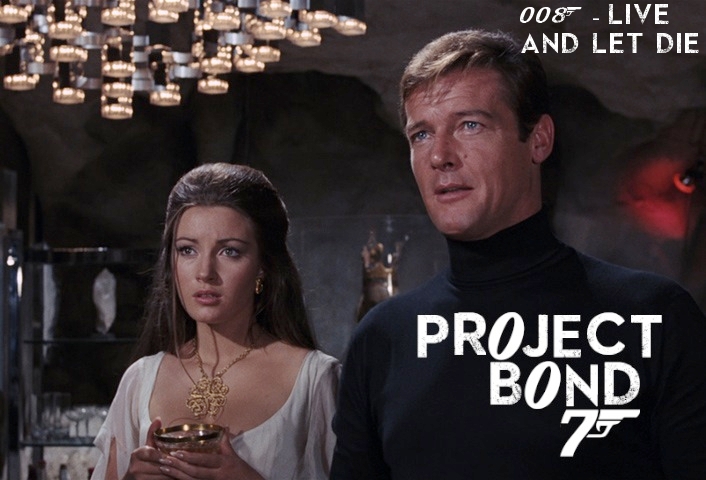
I found this one a bit of a slog, to be honest. By the time the film started properly, I was already irritated by Paul McCartney singing “this ever-changing world in which we live in,” and Roger Moore did not exactly improve my mood. For one thing, he’s no Sean Connery; for another, he’s Roger Moore.
I’m not at all convinced by Moore in the leading role. It would be good if he could add another facial expression or two to his repertoire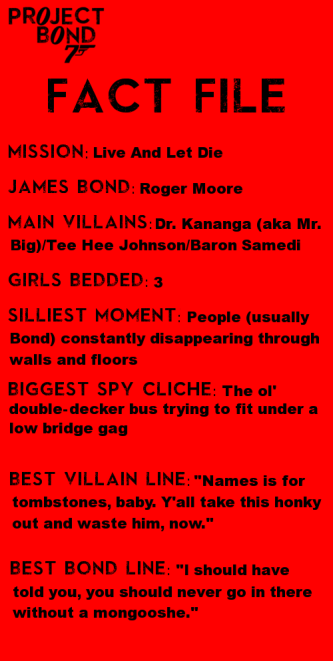 , for instance, and even when jumping across crocodiles’ heads to safety, he looks like a man trying not to wrinkle his suit on his way back to the office. On that subject, his suits of beige and blue don’t seem as fitting for the role as Connery’s blacks and greys. However, Moore does introduce the Tactleneck to the Bond franchise, as pictured above, which is nice.
This film, while entertaining enough in places, seems to go off the rails a bit, bringing in occult elements such as Tarot cards, in which we’re now supposed to believe in.* There are some rather dodgy stereotypes dished out to the black villains of the film, and Sheriff J. W. Pepper couldn’t be more reminiscent of Foghorn Leghorn if he sprouted wings. We also finally get the chance to meet Quarrel Jr., the son of Quarrel, a minor character from Dr. No, who turns up here for some reason.
Plot-wise and theme-wise, this is fairly in keeping with what I’ve seen so far, with Guy Hamilton continuing as director, toning down some of the slapstick and over-explanation of Diamonds Are Forever. Roger Moore has a lot to do to convince me as Bond, I’m sure he’ll be devastated to learn. Fortunately, he has six more films in which to do so. Super.
*Fully intentional error
 Colm Currie