Colm Currie
Writing things so you don't have to
State of the Union
In September last year, when the people of Scotland voted 55-45 against independence from the UK, I was staggered at how many commentators seemed to believe that would be the end of the discussion. “Well, it’s official,” said Conservative, Labour, Liberal Democrat and other Better Together supporters, “the people of Scotland have chosen to stay in the union. Nothing more to be said.” Eight months later, they are astonished that Scots want to have a say in how this union should be run. Not only that, but some of them still seem to be in favour of this ‘independence’ idea that scraped a paltry 45% of the vote in the referendum. It was outrageous, it was anti-democratic, the electoral system would have to be changed. These cries have of course now vanished from the London-run media since the first-past-the-post system has delivered what it is designed to: a Tory majority. As disappointing as the overall result is for 85% of Scots, the vote in Scotland told a fascinating and radically different story.
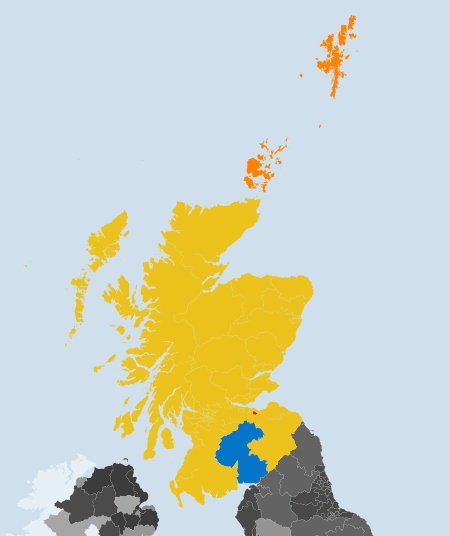
If you had shown this map to a Scottish person five years ago (or probably even one year ago), they would have accused you of having misplaced your marbles, although perhaps less politely. 56 of Scotland’s 59 seats were won by the Scottish National Party, with Labour (traditionally the biggest party in Scotland) dropping from 41 to one. The Conservatives and Liberal Democrats each have one seat, too, with the Lib Dems losing 10 and the Tories recording no change. This is an enormous blow for Labour, but it could have been even worse, with some polls predicting the SNP would win every seat, and they were not far away from this, with even the three constituencies they failed to win recording swings of more than 25% in their favour.
The UK Labour Party has bigger problems than Scotland now, though, having fallen 99 seats behind the Conservatives. Even if every single eligible person in Scotland had voted Labour, the Tories would still have a majority with 331 seats, 40 more than Labour would have. The downturn in popularity in Scotland is due to a gradual slide to the right over the last 20 years, but the standing shoulder-to-shoulder with the Tories during the referendum has done Scottish Labour some damage that could take a generation or more to undo.
Taking most of the heat for Labour’s defeat, understandably, is Scottish Labour leader Jim Murphy, who served as MP for East Renfrewshire until this election. Murphy held several cabinet posts under Tony Blair and Gordon Brown, and was a prominent voice in the Better Together campaign last year, which led to a rather infamous egging. Murphy was a controversial choice to replace Johann Lamont as Scottish Labour leader at the end of last year, partly because he polarises opinion within the party, partly because his seat was at Westminster, not Holyrood. It had been suspected for the last couple of weeks that Murphy would lose his seat, so while his defeat was significant, it was not a huge shock. He has not, however, resigned as leader despite no longer holding office, and despite huge calls for him to go. I’m no Jim Murphy fan, and I took great pleasure in seeing him lose his seat, but these calls seem a little unfair, even to me.
The amount of venom being aimed at Murphy from within his own party is quite perplexing. Of course, Labour members and supporters are hurting in the wake of this defeat, and are looking for someone to blame, so naturally they look to the leader of the party. Following the referendum, there was a lot of hatred for Labour in Scotland, a good deal of which can be attributed to Murphy. However, in the wake of the election, people seem to be mainly criticising him for poor leadership, when in my view he’s been far more vocal and charismatic than his predecessor, and, indeed, hers. The crime of which Murphy is apparently being accused is failing to turn around a massive shift in public opinion in six months, something that I think would always have been considered a tall order for Jim Murphy even by Jim Murphy. As a key figure in Labour’s referendum campaign, the main reason behind their downfall, and as current leader of the party, Murphy must take a lot of responsibility for this disaster. I just get the impression that, from within the Labour Party, there is a disproportionate amount of blame being placed at one man’s door for a self-destruction that was really a team effort. Johann Lamont and the aptly named Ian Gray (remember him?), as well as Ed Miliband and countless MPs and MSPs, all knocked big lumps out of the sinking ship before Murphy took the tiller.
Despite achieving the almost-impossible feat of making Labour unelectable in Scotland, it was largely his party’s performance in England that led to Miliband’s resignation yesterday. Ed Miliband is, for me, the Tony Mowbray of Labour leaders. He’s basically fine a lot of the time, he did his job under difficult circumstances, and I want to like him. There is, however, an ever-present and extremely obvious lack of ability to do the job. “Taking it on the chin” will only get you so far (not very). He either did not know what the Labour-voting and potential Labour-voting public wanted, or he had no idea how to deliver it. Too often he refused to change his tactics when they were not working, and he was an easy target for the media, who (broadly speaking) were delighted to take aim. In several senses, if you’ll allow me to continue my metaphor, Labour could do with a Neil Lennon figure taking the reigns. Someone who is a fighter; someone who knows what he wants; someone who is not affected by the inevitable media criticism; someone who is ginger. The last one is perhaps less important, but it couldn’t hurt.
The bigger issue, though, is not what happens to Labour, but what happens to the United Kingdom, because when all is said and done (and it has been, for now at least) political parties exist to represent people, and it is the people who matter. With such high support for independence at the referendum, it has been suggested that a big SNP win might be a de facto referendum for Scottish independence. I do not agree with this, because a vote for the SNP is not a vote for independence. There are people who voted Yes in September who did not vote SNP on Thursday, while some who voted for the SNP this week voted No in the referendum, so it would not necessarily be accurate to say that Scotland has changed its mind. This result does, however, show that Generation Yes is not going away just because Westminster wants it to. The Tories promised further devolution for Scotland, Wales and Northern Ireland, something David Cameron reiterated yesterday after his majority was confirmed. Whether or not he will follow through on it remains to be seen; the cynic in me says he’ll find some flimsy excuse. There are, however, 56 MPs who will make it their business to remind him of his “vow,” and make it more difficult to ignore.
I would vote Yes in a referendum on Scottish independence tomorrow, but I would not be in favour of holding a second one so soon after the first. I don’t think enough time has passed for the reality of what we have signed up for to have sunk in for everyone, and I expect the result would be the same, although with a smaller margin. I would, however, suggest that the SNP demands a second referendum in the event of the UK voting to leave the EU. Given how much of Better Together’s rhetoric was around losing the stability of the EU, it would be preposterous for people to have voted to stay part of the UK in order to remain in the EU, only for the UK to defect so soon afterwards. Scotland knows how much it benefits from being part of the EU, and should not have to lose that because the rest of the UK has had enough of the dreaded immigrants.
Scotland spoke in September, and the rest of the UK was only too happy to listen. It has spoken again in May, and so they must listen once more. This is not a blip or a protest vote, and it is not (just) about giving the effing Tories a kick. This is a generation that wants a greater say in how its country is run, and I don’t see it giving up. This is a Scotland of which I am proud to be a part, and a United Kingdom of which I am not.
 Colm Currie