Colm Currie
Writing things so you don't have to
The US Office: The same, but different
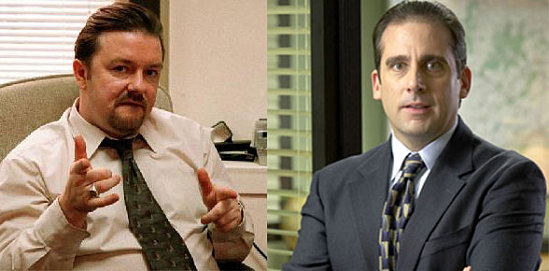
Because I like to stay topical and have my finger firmly on the cultural pulse of the world, I have recently started watching the US remake of The Office, which had been recommended to me by several people. As a British person (which is not how I normally identify, but it is relevant here), I am much more familiar with the original BBC version, written by Ricky Gervais and Stephen Merchant. The original is revered as a classic (or a modern classic, depending on what constitutes modern), and I was more than a bit skeptical about the remake. Having seen pilots for US versions of Spaced and The IT Crowd, I saw nothing that would make me want to watch the US Office (I only made it halfway through the Spaced pilot before I had to stop due to how agonising it was to watch). Then again, The Office ran for nine seasons on NBC, whereas neither of the aforementioned pilots was ordered to series (although The IT Crowd is set for another remake, this time with creator Graham Linehan’s involvement, and sitcom guru Bill Lawrence attached, so it will probably be less awful this time). Gervais and Merchant were both involved in the remake of The Office, and I know a few people who are fans of both versions, so based on this, I decided to give it a chance.

Image: BBC/NBC/popsugar.com
I am halfway through the second season, and I must say I am enjoying it far more than I expected to. This is not because I am snobby about American TV; British comedy was once great, but The Office is one of very, very few good sitcoms we have produced since the 1980s, in my opinion. These days, the USA is streets ahead (sic) of the UK when it comes to comedy, and to television as a whole. My reservations about the US version of The Office mostly came down to my inability to understand the appeal of a remake. If something is good, it’s good, and doesn’t need to be redone. If something is bad, it’s bad, and you would surely be better off making a new thing from scratch. I understand the accent/cultural barrier argument, but this goes out the window when The IT Crowd US pilot was practically a shot-for-shot and word-for-word remake of the original, and starred Richard Ayoade as Moss, making no attempt to alter his accent. So, I thought, if a couple of American TV writers saw and enjoyed The Office, would they not have been better off just making a brand new show set in an office, with completely original characters?
The answer, I have now concluded, is no. Based on a couple of episodes I’d seen years ago, which had failed to capture my interest, and some YouTube clips, which had done likewise, I did not see much similarity between Michael Scott and David Brent. Now, however, the parallels are quite clear to me. Both men are uncomfortable in a management position, keen to remain friends with their co-workers, and have little or no idea how to use their power. Both have prejudices that they attempt to conceal, generally quite poorly, and are rather sleazy. I read that Gervais and Merchant advised showrunner Greg Daniels (who would later co-create Parks & Recreation, a show I love) to make Michael’s character more sympathetic than they had Brent, because he often came across as nasty. This difference in writing the lead character is quite clear from the beginning; Michael seems more like a guy who means well, whereas Brent seems mostly concerned with his image and how others perceive him. It’s not that this isn’t part of Michael’s character, but it appears to be a less important matter to him than it is to Brent. There’s a hint of Alan Partridge about him: he’s a bumbling moron, with a strong desire to be popular and well-liked, but Michael comes across as a much more likeable guy than Brent. David Brent is one of the all-time great comedy characters, but it is very difficult to feel sorry for him, because a lot of the time he behaves like a weasel.
The characters are the same, but different. The four main characters – Michael Scott, Jim Halpert, Dwight Schrute and Pam Beesly – are the only ones closely based on characters in the UK version (David Brent, Tim Canterbury, Gareth Keenan and Dawn Tinsley respectively), although there are similarities between some of the other characters. Dwight and Gareth are both odd, unlikeable people, with ideas above their stations who admire their respective bosses, but Dwight (so far, at least) seems less disturbing than Gareth. He is less sleazy, and his inappropriate questions and statements seem to come more from a misunderstanding of what is okay and what is not okay than from prejudiced attitudes and general nastiness (although there is an element of the latter as well). His relationship with Jim is similar to Gareth’s with Tim; they dislike each other, but there is no serious animosity there, and for Jim/Tim’s part, winding up Dwight/Gareth is mostly just a way to make the day go by a little faster. Jim hates his job and would surely leave were it not for Pam, the receptionist with whom he would like to be more than friends. Pam is, however, much like Dawn, engaged to a man who works in the warehouse, a man the audience is clearly supposed to dislike for the way he treats her. I rooted for Tim and Dawn, but not as much as I already do for Jim and Pam.
The setting and characters, then, are very similar to the original series, with the main difference being the style of the humour. While the UK series was extremely cleverly and intricately written, and revolved around a lot of cringeworthy moments and awkward silences, I am so far finding its US counterpart to be a bit more formulaic and predictable, but also more laugh-out-loud funny in places. For instance, an episode I watched the other day featured a sub-plot in which Jim learns that Dwight believes it to be Friday when it is in fact Thursday, and he and Pam attempt to “keep that going” so that he does not come in on Friday. It sounds very simple, but it was so brilliantly executed that my face hurt from laughing, which does not happen often. Gervais and Merchant would not have touched an idea like that, and if they had, I doubt they would have pulled it off as well.
I am very pleased to know that I have another seven seasons of this awaiting me, even if the quality does decline towards the end, as seems to be the consensus. Gervais and Merchant often spoke of their desire not to dilute the quality of their series by letting it continue for years, and cited the example of Fawlty Towers, which ran for only 12 episodes, each of them a masterpiece. This is an admirable position to take, and one that certainly worked; the original version of The Office is almost universally acclaimed, and rightly so. However, this is also one of the reasons I think UK TV is so far behind the US: we don’t make enough shows, and of the ones we do make, we don’t make enough of them. Of course, it’s all subjective and comes down to taste, but it’s very difficult to get into something that has only a handful of episodes. One of the reasons I prefer TV to film is that you can get to know the characters and the setting very well, something that is largely lost when there is so little of it. This does mean that we are left with a few televisual gems with very short runs (Black Books and Spaced are two of the best examples I can think of besides The Office), and these shows are heaped with deserved praise, but we want more. I’ve never met anyone who watched all 14 episodes of Spaced and said, “I’m glad they stopped there, it was getting old.” It wasn’t at all, and I’m sure they could have done another series or two without letting the quality dip. We need to start having a bit more faith in our ideas, because, as the US version of The Office shows, there was potential for more great things to come from that setting. (I’m sure it suits Gervais and Merchant just fine the way things turn out, because they get plenty of money and credit from the remake, but had it been a disaster, their brainchild would still have been held up as the comedic yardstick it is.)
In short, I can see a great deal of merit in this particular remake. Greg Daniels saw an excellent sitcom, one that didn’t strike a chord with that many people on his side of the Atlantic, and saw a way to tweak the format ever so slightly to make it appeal to a much larger American audience. Fair play to him; that’s not something I would ever have expected to work well. I’m enjoying the series so far, and plan to continue watching, and I’m pleased to note that I can find different things to like about both series, as well as some that they have in common.
 Colm Currie