Colm Currie
Writing things so you don't have to
Neil Lennon: Farewell to a Hero
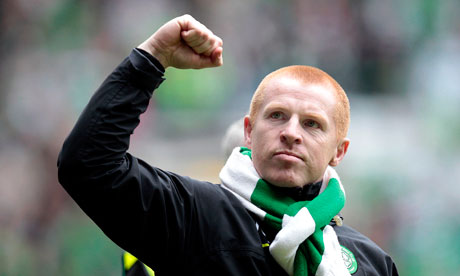
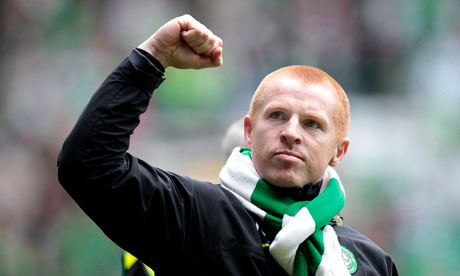
Tomorrow I will make the familiar journey to Celtic Park for the first time in several months. While there will be plenty to celebrate, with a new manager, a new season, a new pitch, the unfurling of the league flag, and the return of Fergus McCann, the man who saved the club from bankruptcy in the 1990s, there will be one crucial component missing from the Celtic that I have long known. Having only spent 24 years on this earth, I have seen few people pass through Parkhead’s gates who can rightly be called Celtic legends. Henrik Larsson is one; Neil Lennon is another.

Image: dailymail.co.uk
I recall my dad happily telling me in 1994 that a man named Tommy Burns was the new Celtic manager. This didn’t mean much to me at the time, and I don’t know why I remember it so clearly, but it is very important to me now because it is my earliest memory concerning Celtic. It would be five years before my first visit to Celtic Park, for a friendly with Leeds United, which was John Barnes’ first game in charge. Celtic lost 2-1 in a match that is more memorable to me for off-the-field incidents, including my uncle buying me my first Celtic scarf, and my dad missing most of the second half due to being stuck in the queue behind somebody who had ordered 45 Fantas. Not living close to Glasgow, I didn’t get to a lot of games, and by the time of the next one I attended (Tom Boyd’s testimonial), Barnes was a distant memory and Martin O’Neill was now the Celtic manager, having promised to do everything he could to bring some success to the football club. (He did fine.) One of the players signed by The Blessed Martin was one of his old charges from Leicester City, a Northern Irish central midfielder by the name of Neil Lennon. I remember little about that night apart from the score (2-0 to Manchester United) and my being outraged at the removal of Lennon from the pitch at some point in the second half. I had been impressed with him and, not having had quite as much experience of professional football as O’Neill had, I could not fathom why this midfield titan was being withdrawn.
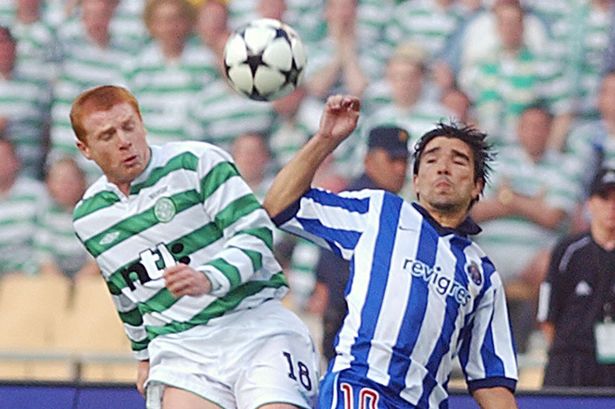
Image: dailyrecord.co.uk
Over the next few years, I watched the majority of Celtic matches that were broadcast on TV and usually managed to attend a few each season. This was a great time to watch Celtic, with a number of talented players in the team, including Henrik Larsson, Ľubomír Moravčík, Stiliyan Petrov, Bobo Baldé, Chris Sutton, Paul Lambert, Johan Mjällby, Alan Thompson, Didier Agathe, John Hartson, Jackie McNamara and Joos Valgaeren. These men became heroes to me, but most were only around for a short time. Gordon Strachan replaced Martin O’Neill in 2005, and by the time he guided Celtic to the Last 16 of the Champions League the following year, Neil Lennon was the only one left (with the obvious exception of Baldé, but that’s a long story.) He served as club captain for two years under Strachan, before leaving in 2007 with an impressive haul of 11 medals. After brief spells playing with two English clubs, Neil Lennon was back at Celtic less than a year later, when Strachan asked him to return as a coach. He continued in this role until Strachan was replaced with Tony Mowbray, at which point Neil began working with the reserve team.

Image: eveningtimes.co.uk
Mowbray’s tenure was less than spectacular, and he departed less than a year later, with Neil put in temporary charge until the end of the season. With no managerial experience, it was deemed unlikely that Neil would be given such a big job on a long-term basis, but he impressed immediately, winning all eight remaining league matches, while Mowbray had not managed three in a row all season. Celtic’s Scottish Cup semi-final defeat to Ross County notwithstanding, Neil seemed to have instilled a unity and a winning mentality into a team that had previously lacked a backbone. Although he was seen by some as a cut-price option, I was delighted when Neil was unveiled as the new permanent manager of Celtic in June 2010. He famously announced that he was going to bring back the thunder to Celtic Park, and he certainly did that. Rarely if ever had I heard the stadium as loud as it was for several games during his first full season as manager. Neil made some excellent signings in his first transfer window, with players like Fraser Forster, Gary Hooper, Kris Commons, Emilio Izaguirre, Beram Kayal and Charlie Mulgrew forming the spine of the team. He also managed to get the best out of Georgios Samaras and Scott Brown, two players who had struggled for consistency since their arrival. Celtic missed out on the league championship on the final day that season, and lost the League Cup final in extra time, but triumphed in the Scottish Cup to round off what was a hugely impressive first season in management.
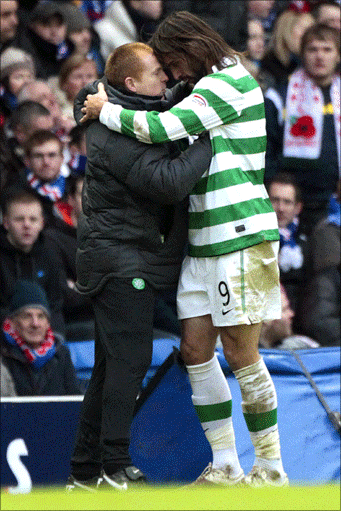
Image: news.bbc.co.uk
Neil built on his success over the next few seasons, winning three consecutive league championships and another Scottish Cup. He brought in new players, and made considerable profits on some of his earlier signings. He also found success in Europe, twice guiding Celtic to the group stage of the Champions League, and once progressing to the Last 16. The 2-1 win against Barcelona was a clear highlight, but it was far from the only one that season, with a fantastic away win against Spartak Moscow, and late drama in the home game against the Russian side as Commons converted a penalty kick (via the crossbar) to seal Celtic’s progression. Last season, Neil delivered his third league title in double-quick time, and his team broke a couple of defensive records along the way.
Neil’s departure came as a huge surprise to me, and I’m still not sure I have properly processed it, nearly three months on. Neil has been such a major part of my life as a Celtic supporter, to the point that I have spent very little time at Celtic Park when Neil was not there. As to why Neil Lennon has left a job for which he seemed like a perfect fit, I can only speculate. His life in Glasgow was not without incident; he received abuse on a regular basis, as well as occasional death threats and physical attacks. His passion on the pitch and on the touchline often landed him in trouble with the SFA, and certainly contributed to his status as a controversial figure in Scottish football, but not to the same extent as his background and his connection with Celtic. While Neil dealt with his unpopularity extremely well and with a great deal of bravery, I could not have blamed him if he had chosen to walk away from it at any point. Indeed, I was surprised and pleased by his resilience when he opted to stay after a debut season in the dugout during which he was sent bullets and bombs in the post and assaulted by a spectator at Tynecastle. It is quite possible that this strain had finally become too much for Neil and his family. He may also have simply wished for a new challenge or a bit of time off from the game. Then again, it might have been more to do with the level of control he had over the team. His team last season was considerably weaker than that of the previous year, due to the sale of key players who were not adequately replaced. Neil may have decided to leave the club because he did not want to be held responsible for an inevitable downturn as the board continue to focus more on matters off the field than on it; early signs under his successor Ronny Deila have done little to contradict this theory. I would estimate that Neil’s departure is down to a combination of these reasons, with the latter being the most significant.
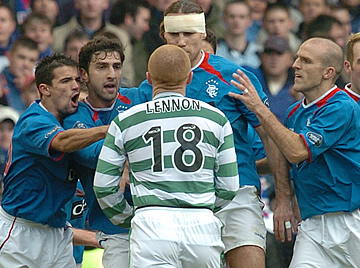
Image: 4.bp.blogspot.com
Ronny was something of a surprise replacement for Neil, with a number of Celtic fans not having heard of him prior to his being linked with the club. Early results have been mixed, as is to be expected when a new manager comes in, and it is still too early to properly predict how Ronny will do. As Celtic manager, he has my full support, but in terms of securing the adoration of the fans that Neil enjoyed, Ronny has some big shoes to fill. Never having played for the club, he is at something of a disadvantage. Neil’s previous connection with Celtic is of course what led to his getting the job in the first place, but, while he was loved by the Celtic support and given a great deal of backing, I do not think this clouded people’s judgement of him as a manager. He was often critiqued by the fans, myself included, and his success was more to do with his winning mentality than his Celtic mindedness.
With Tony Pulis leaving his job last night, there is already speculation that Neil will be considered as his replacement by Crystal Palace. So far, Neil has been tight-lipped on what lies ahead for him, but for the foreseeable future, he is likely to be linked with most vacant managerial positions in the Championship and lower Premiership until he takes on his next job. Considering that Pulis was apparently involved in a dispute over his budget at Palace, it seems unlikely that Neil would be especially keen to go there, but I wouldn’t rule it out. He would be likely to have more funds at his disposal than he did at Celtic, and he is no stranger to finding a good bargain in the transfer market.
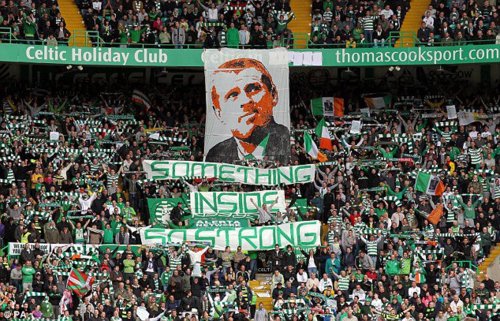
Image: talkceltic.net
It is easy to see why Neil Lennon is held in such high regard by the Celtic support. As well as being a solid defensive midfielder and a faithful servant to the club, traits that continued into his managerial reign, he has always been something of an outcast in Scotland. Celtic fans have it much easier today than they used to, but historically it has been very dangerous to openly support Celtic in Scotland due to religious and political tensions. Neil Lennon arrived in Glasgow in 2000 and personified much of what is great about this football club. Often a target, Neil has a strong personality, a resilient attitude, and a hunger to succeed. In more difficult times, Neil has often served as a rallying point for fans, and has helped to bridge the gap between the stands and the pitch. His enormous presence will be sorely missed by all in the Celtic support. For me, with my very few memories of a Celtic without Neil Lennon in it, it is extremely difficult to say goodbye to an ever-present hero of my youth.
 Colm Currie
Great post my bhoy! Absolutely spot on. Very proud! 🙂