Colm Currie
Writing things so you don't have to
Breaking Bad: How Does Walt Win?
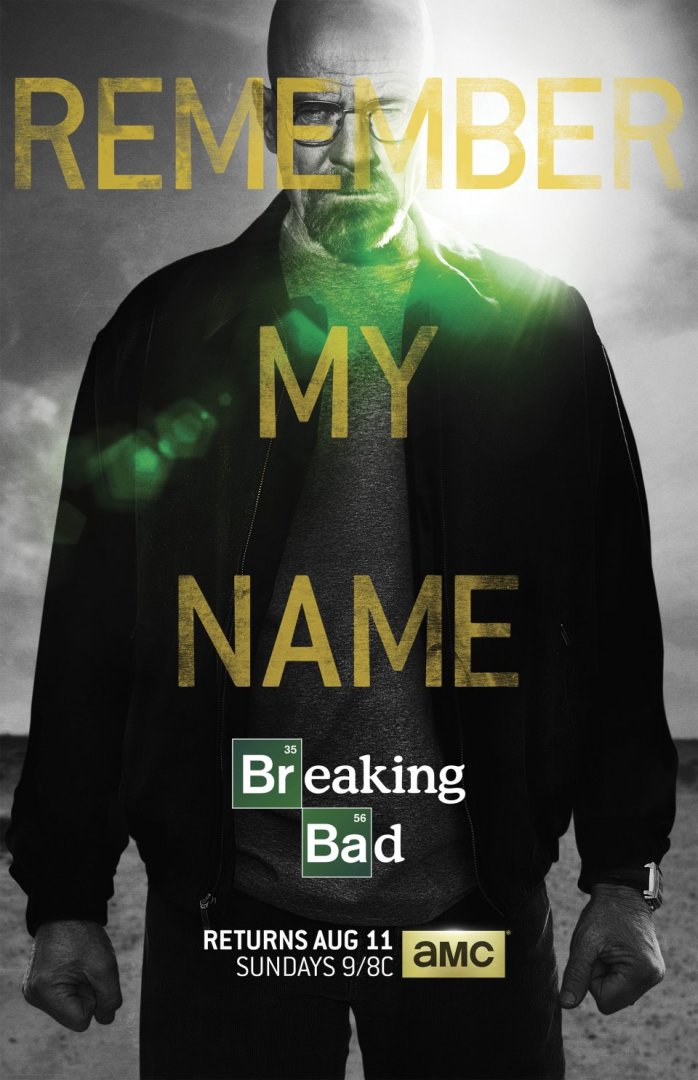
Before you read on, I should once again tell you (since I don’t want to receive any death threats) that this contains spoilers up to and including the most recent Breaking Bad episode, Granite State. If you’re not up to speed and don’t wish to have the show spoiled for you, you continue reading at your own risk. Don’t say I didn’t warn you.
I’m a member of Team Walt; I have been since the beginning and, having come this far, I intend to see it out. His actions have often been deplorable, and I do not condone them or him as a person, but as a character I love him. I want him to win, but I don’t see how that’s possible any more.
When we last saw Walt, at the end of Granite State, it is implied that he has left the bar in New Hampshire to return to Albuquerque, as seen in the flash-forward opening scenes of Live Free Or Die and Blood Money. He has nothing left. His cancer is back; his brother-in-law is dead; his family is in ruins, not speaking to him, and he can’t get any money to them; his partner is a missing-presumed-dead traitor; he’s so thin that his wedding ring (which he is quite clearly not wearing in the flash-forwards) falls right off his finger as he coughs himself to sleep one night. He has more than $10 million and nothing on which to spend it. He has an unknown, but apparently short, amount of time left to live. He is so lonely that he paid a man $10,000 to play cards with him for an hour. God only knows how many times he’s watched Mr. Magorium’s Wonder Emporium. Perhaps even more times than I’ve watched Granite State, and found myself emotionally unprepared for almost everything in it. If ever there were a time to call Saul, this is surely it, but there’s no telling which Omaha Cinnabon he’s managing these days. Walter White, Heisenberg, Mr. Lambert, Ozymandias; call him what you will, he surely cannot win now.
The only things he has left to live for are the various vendettas he is still pursuing, and his quest to ensure that his family is taken care of (as I covered earlier this week). He wants Jesse dead, and he wants Jack’s band of lunatics dead, but he is more than 2,000 miles away from them and the subject of a huge manhunt. He wants to get what’s left of his money to his wife and children, but as far as he knows, they don’t want anything from him, and there are plenty of obstacles in his way. The best case scenario that I can see for Walt is that he returns to Albuquerque undetected, wipes out the Nazi gang who murdered Hank, slips some money to his family somehow, and gets out of there and back into hiding. Short of that, he’ll be hoping that his cancer takes him before he spends too much time in jail. I think that would be incredibly tough for Walt to take, given the measures he has taken to keep himself safe so far.
His plea to Walt Jr. on the phone at the end of Granite State was extremely telling. “It can’t all be for nothing,” he said, as his son continued to accuse him of murdering Hank. Walt started in the meth business (before moving into the money business and subsequently the empire business) to provide for his family, as I wrote about extensively the other day. His primary objectives were to pay for his medical treatment, provide for his family’s general life after he was gone, and afford a good education for his children. If he wastes away in a New Hampshire shack, and the vacuum-cleaner repairman takes his cash, he’s only achieved one of these objectives. He has prolonged his life slightly, but filled it with despair and torn his family apart in the process. If he dies without being able to make a further contribution (and it would need to be a major one) to his family, then he has failed. Nobody likes to fail, and nobody likes not to be in control of his life and his circumstances. Early on in the series, Walt took very definite charge of his circumstances.
Once again, I’m going to look at events in Gray Matter to underline this idea. There is a very emotional scene around halfway through the episode, in which Skyler, Walt Jr., Hank and Marie stage an intervention for Walt, after he refuses to accept Elliot’s offer to pay for his cancer treatment. Walt defends his stance by outlining what his final months on earth might be like if he underwent chemotherapy. “These doctors, talking about surviving, like it’s the only thing that matters. But what good is it if I just survive, too sick to work, to enjoy a meal, to make love? I don’t want to choke down 30 or 40 pills every single day, lose my hair, and lie around too tired to get up, and so nauseated that I can’t even move my head.” It’s a pretty bleak picture, right enough, and nobody wants to go out like that. All of that makes perfect sense. But then there’s a little coda to Walt’s speech, which could easily have been brushed over at the time, but now seems hugely significant: “And that’s how you would remember me. That’s the worst part. I choose not to do it.” Walt doesn’t want to be remembered as a weak, dying man, which, again, is understandable. But this theme returns later in the series, as it becomes clear that Walt wants to be remembered as a winner.
In season four, after Walt has too much to drink and suggests to Hank that perhaps the late Gale Boetticher is not the mastermind drug lord he was after, Skyler puts it to him that part of him wants Hank to catch him. Walt rejects this idea out of hand, but it appears to have touched a nerve. I think she’s definitely got a point here; despite its illegality, Walt’s rise to power is impressive. Power corrupts, and can build up a person’s ego, which has clearly been the case with Walt. Hank, who spends his days busting criminals, looks like a big shot to some (including Walt Jr., who seems to idolise his uncle), whereas Walt Sr., as a mere teacher, does not. Walt may well be interested in impressing Hank, although when he eventually does find out, he’s more shocked and disgusted than impressed. He’s certainly not happy about his work being attributed to Gale, rather than to Heisenberg.
In the first episode, we see Skyler give Walt a row for using the wrong credit card. It’s a small thing, but it gives us the impression that Walt is not in full control of his life. When Hank takes him on a ride-along to a drug bust, the idea of cooking crystal meth begins to form, and he likes it. He doesn’t have much time left; why not do that? Why not start a new venture, something Skyler doesn’t know about? Something nobody knows about. It will give him something in his life that he can control. Of course, for a father and husband, this is a ridiculous thing to contemplate, so he has to fool himself into believing that he is doing it for his family (again, see here for more on this idea). In Gray Matter, just before his “remember me” speech, Walt says: “Sometimes I feel like I never actually make any of my own choices. All I have left is how I choose to approach this [dealing with cancer].” The choice he ultimately makes is to get the treatment, funding it independently, by cooking meth and building his drug empire.
Walt’s pride is also something that has been hinted at various times throughout the series. In Gray Matter, as he attend’s Elliot’s birthday party, he is surrounded by successful associates of his successful former business partner. When asked if he is still involved in the company, he replies that he “gravitated toward education,” then avoids answering the question “what university?” It is often suggested that Walt is a highly skilled chemist (describing himself as “an extremely over-qualified high school chemistry teacher” in Bit By A Dead Bee), but early on it is established that he loves his job. There is no need for him to be ashamed of teaching school rather than university, yet he seems to be. Even amongst strangers, when he has far bigger things such as cancer on his mind, Walt wants to maintain high levels of pride. In the final scene of Granite State, he bristles as Elliot and Gretchen downplay his contribution to Gray Matter Technologies on national television.
Of course, they did this to distance themselves from a wanted drug lord, but it still angers Walt. Having realised, following his phone conversation with Walt Jr., that his family would be better off if he turned himself in, he changes his mind when his part in the company he co-founded is undermined. That said, I don’t think he is likely to kill or even do anything to the Schwartzes. He has 2,200 miles to drive, and the 30-hour journey (assuming all he stops for is gas) will probably cool him off a bit. His serendipitous spotting of them on TV is little more than the catalyst for his inevitable return to New Mexico, or so I think. I could well be wrong; Breaking Bad is not afraid to throw viewers the occasional curveball.
I know there are plenty of people who don’t have any sympathy left for Walt, and don’t understand why anyone still wants him to win. My answer comes down to two main points: it’s not real (there are plenty of great characters out there who are awful people), and he has been led astray a great deal. Admittedly, this was often his own fault, and it doesn’t excuse what he’s done, but it is certainly a factor. Moreover, with Hank out of the picture, I don’t see who else there is left to root for. Without a familiar, relatable character such as him there, anyone who wants Walt to be caught and sent to jail is thinking exactly what the government wants them to think, if you’ll excuse me as I adjust my tin foil hat. Further, if you watched Granite State and didn’t feel any pity or sorrow for Walt, then I don’t trust you at all. As if paying thousands of dollars for an hour’s company wasn’t bad enough, he was then given dog’s abuse by his son and came face-to-face with the embarrassing reality that Saul had been right all along. Soul-destroying stuff, I hope you’ll agree.
For what it’s worth, I think Walt will survive the finale, or if he does die, it will be from cancer or by his own hand. He’ll settle his disagreement with Todd and his associates, and he’ll allow Jesse to live. Their relationship was mostly business, but there was certainly a mutual affection there, and that doesn’t just disappear. Walt could have killed Jesse himself at To’hajiilee, but he didn’t, and I don’t think he can. This is the least Jesse deserves; after all, he’s always been a better friend to Walt than vice-versa. Jesse could live with Walt having killed Mike (he always thought this was what had happened, without knowing for sure), but finding out about his poisoning Brock and allowing Jane to die will have hurt him too much for things ever to go back to how they were. I don’t really have a theory on who the ricin is for, or how things will end up between Walt and what’s left of his family. I hope that Walt goes out on top. I hope that we see Saul and Huell, in a montage at least, and I hope Jesse calls everyone a bitch. Other than that, I just want to enjoy the final episode of what has been an incredible piece of television and a hugely satisfying ride.
 Colm Currie
Pingback: Walter White, Family Man | Colm Currie